thenumerateninny.com
Natterings of a Woman in STEM
The Two-Year-Old Engineer
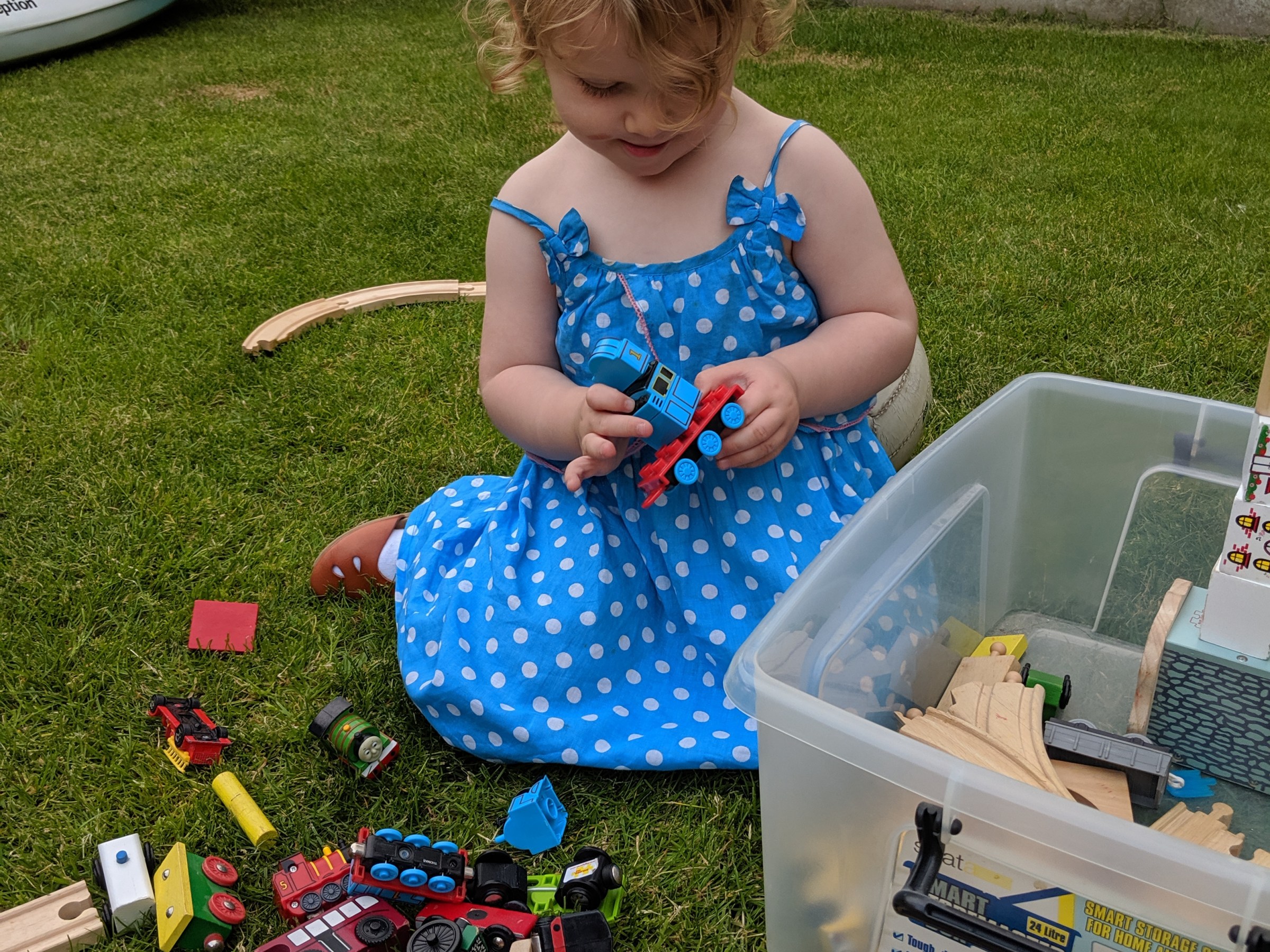
Recently, I had the privilege of watching my 2½ year-old grandniece, Penny Rose, at play. Deeply engaged with a Thomas the Tank Engine Lego set, she connected the brick with Thomas’s face to a foundation brick. She then tried to place a piece of Thomas’s body beside his big happy grin. But Thomas’s nose stuck out and prevented placement! Undeterred, she removed Thomas’s face-brick, put it at one end of the base piece and successfully connected all three pieces of Thomas’s body. Not content with these efforts, she disassembled her work and explored other configurations to determine which would work and which would not.
You don’t need to be an educator to understand that this little toddler was developing her spatial reasoning skills – and you don’t need to be a great-aunt to be impressed by the little one’s focus.
“She’s going to be an engineer,” this auntie declared proudly, as the little girl worked on.
This was a more significant declaration than you might think. I have often lamented my lack of familial connections to engineering. Family history says I have an ancestor who was a boilerman in the days when boilers were fickle things that needed constant feeding to make them work and coddling to prevent them from exploding. However, there were no living technical mentors within the family circle when I was a child. In fact, I never even met an engineer until I went to university.
Alas, my subsequent life experience has taught me that those who grow up in an engineering household are more prepared for the profession than those who do not. Engineers breed engineers, or so it seems. My engineer-free upbringing was a professional disadvantage. Woe be me. So, to see a petite person connected to me by blood enamored with practical geometry was a special treat.
It would be a genetic stretch to say that my grandniece inherited some special aptitude from a great aunt who is an engineer. Penny’s mother’s abilities are more aesthetic than technical. (In fact, I should apologize to my stylish niece for my perennial frumpiness.) On the other hand, Penny’s dad, unconnected to me by birth, is a mechanic. Her abilities likely come from him.
We all know there was a time when women were declared – by virtue of their gender – to be devoid of certain skills, talents, and abilities. In fact, I am old enough to have heard such prejudices declared openly. (Hard to believe I’m that ancient, is it not?)
But even when I was still a tiny thing, I had trouble rationalizing these established notions. I saw little girls inherit their father’s looks, musical talents, and medical complaints. I could not determine how they were barred from inheriting their father’s technical skills, athletic abilities, or ability to reason.
Yet society assured us that girls were incompetent at tasks that involved scientific knowledge, spatial awareness, or mathematical skills. This was supposed to be true even if they were descended from a male line with proven excellence in those fields. (The female line had little opportunity to prove anything, of course.) The accepted and false logic was that male skills were passed to sons (even those who were very like their mothers) and those same skills bypassed daughters (even those who were very like their fathers).
As a result of these commonly postulated viewpoints, young girls and women who declared an interest in engineering, or other ‘manly’ professions, had their declaration met with exclamations of “You can’t do that”. This retort was often accompanied by a laugh or a sneer or some other variant on contempt. The negativity had a double meaning. Women could not do that because they were both deficient in ability and because doing that was not permitted by society.
Sadly, my belief that I belonged to the last generation to be exposed to this nonsense has recently been shattered. Through social media, I have become aware that the youngest of women in STEM fields feel the resonance of chauvinistic opinions that were once so openly expressed. I can only hope that, since such prejudicial comments are now rarely voiced aloud, young women stay long enough in their STEM professions to make the concept of female competence utterly unremarkable, yawningly boring, and unworthy of comment.
As for Penny Rose, when I repeated my thoughts on her future profession, her dad proudly announced, “I’d be all right with that”. Well done, Denis! The world needs more of that attitude.
Follow The Numerate Ninny on Facebook, Instagram, Twitter, LinkedIn or at: https://thenumerateninny.com/
Find my books on all Amazon platforms.
 thenumerateninny.com