thenumerateninny.com
Natterings of a Woman in STEM
Inflammatory Language
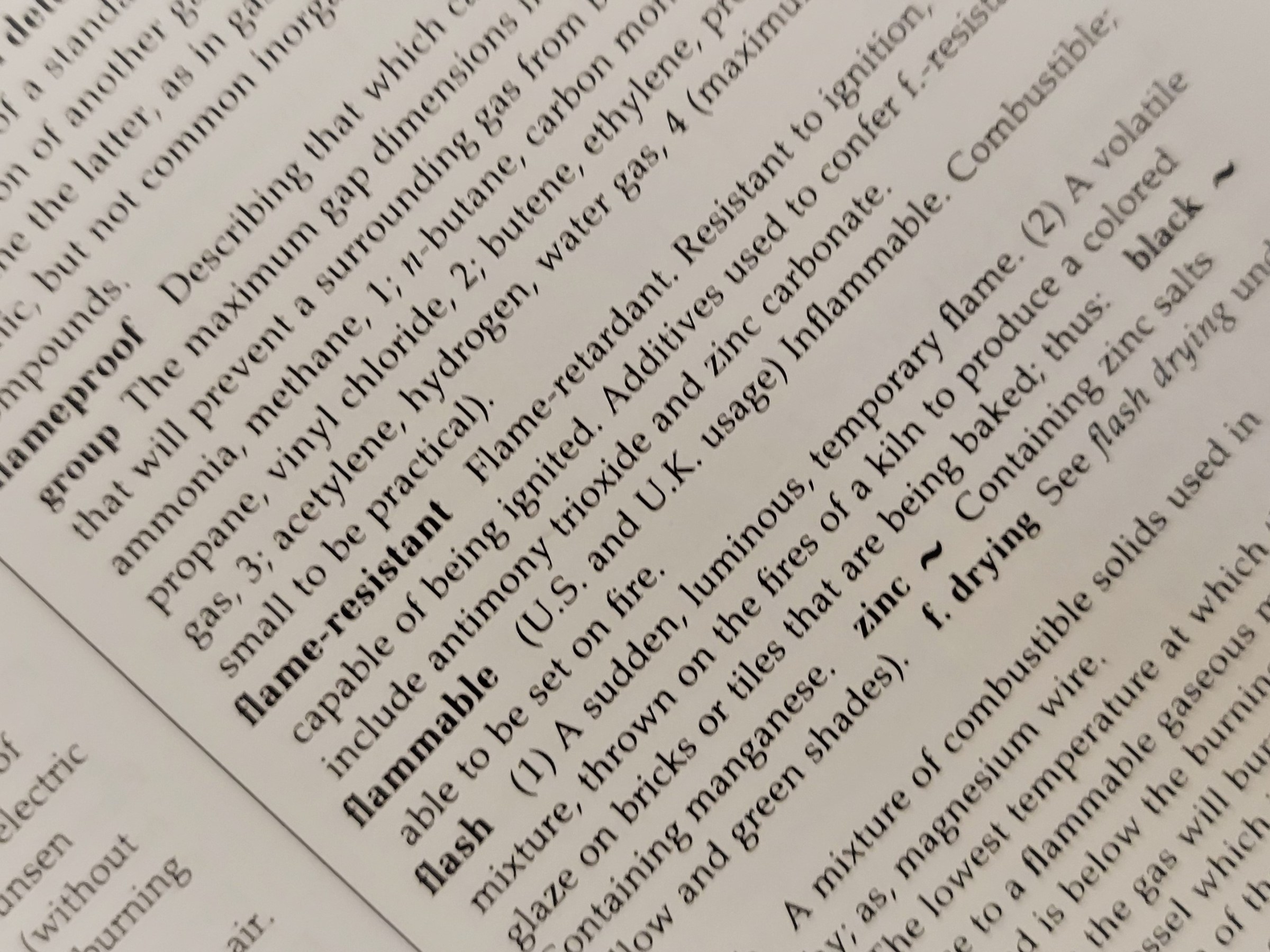
Scientific language is a fickle beast.
If you’ve been around for a few decades (and have been exposed to changing language) your experience can be a liability.
Take, for instance, the word flammable. It pretends to be an uncomplicated word. In fact, the OED simply defines it as:
“that which can burn easily”
And dictionary.com defines flammable as:
“Easily set on fire”
Although not technical definitions, both definitions are perfectly clear in their meaning and can be applied equally to solid, liquids, and gases.
However, in the engineering world, we confine the use of the word flammable to materials in their liquid or gaseous state. (Oh, dear! We are only beginning to explore the topic, and already the meaning of the word has shifted depending on the audience.)
I’ll take a trip down memory lane to further muddy the waters.
Inflammable: When I was a sprig in the 1980s and 1990s, this was the term for liquids and gases that burned. As far as I know, the word dates from time immemorial.
Flammable: This uncouth American term caused language purists around the world to cringe for decades. Despite this, the word has made inroads internationally. My first experience of flammable was in the 1990s, when this truncated word grated on my ear quite dreadfully.
Persons unfamiliar with the English language sometimes mistook the word inflammable for its opposite, non-flammable. An inflaming circumstance! Loath as I am to admit it, the use of the American word flammable prosaically resolved this issue.
Combustible: No thanks to the NFPA for muddying the meaning of this word. Per the NFPA, the word combustible distinguishes between liquids with flashpoints above 140⁰F (38⁰C) and more hazardous liquids with lower flashpoints (which are still considered to be flammable).
(Sadly, the internet was unhelpful in my search for the date when this differentiation first came into play. My faith in the internet as a source of quality information has been deeply shaken.)
Ignitable Liquids: Kudos to FM for this reminder that the distinction between flammable and combustible liquids is a little dubious. The term, ignitable liquid, came into use around 2014 and refers to any liquid with a flashpoint. In the 2021 Edition of NFPA 30, Flammable and Combustible Liquid Code, the NFPA deigned, in its munificence, to include this term.
But why invent a new term, my aging brain asks? Couldn’t we have simply used inflammable?
DOT Definitions: The US Department of Transportation regulates the labelling and transportation of liquids that burn. However, they only regulate ‘combustible liquids’ with flashpoints up to 200⁰F, totally ignoring the plethora of other liquids that burn.
In practical terms, does it matter what language we use to address the hazard of materials that burn? In my opinion, it does.
Here are some ways in which energy, time, and patience are wasted due to varying terms and language:
- The discussion that prompted this blog post related to the use of the term ‘flammable liquid’ in a technical tome. We finally concluded the author was using the term in its truest sense—as it related to all liquids than can burn. It was improbable that, as a researcher, he was aware of the artificially limited meaning of the word used in US codes and standards. (There went fifteen minutes of my life I will never experience again.)
- When dealing with US-based warehouse personnel (who are very conversant with US DOT regulations) it is nearly impossible to convince them that products with flashpoints above 200⁰F can burn at all. In the mind of everyone’s favorite logistics manager, the product is non-combustible, non-flammable, and will not contribute to a fire! Sigh! Not this conversation again…
- The separation of flammable/combustible/ignitable liquids into various classifications can lead process designers to view the material hazards as increasing in a step-wise fashion. What a questionable perspective to have! The hazards increase incrementally. That’s just how nature works.
- Classifying liquids as flammable or combustible based on flashpoints may be a valid measure of ignitability. However, flashpoint is a singular metric. It is easy to forget it is only a small part of the material’s hazardous profile. Focusing on one attribute can lead us to place less emphasis on other important characteristics. Heat release rate, viscosity, solubility, density, toxicity, etc. are just as fascinating as flashpoint, don’t you think?
Science is immutable—and may not be influenced by the language that describes it—but language definitely influences how we, frail humans that we are, apply science.

 thenumerateninny.com