thenumerateninny.com
Natterings of a Woman in STEM
Twelve of One; A Dozen of the Other

If your lover sent you eleven roses, how would you feel? If your package of baked goods contained only ten buns, would it seem right? Not at all! You would feel undervalued, shortchanged, or cheated.
We pretend that numbers are logical devices, free of emotional resonance, but that’s a false premise. Twelve is a number with a special significance; one to which we attach a totally irrational value.
Why is twelve so special to us?
Twelve measures the rhythm of human life. Our ancestors, who were better connected to nature than us, were deeply aware of the twelve lunar cycles in a year. Early calendars and modern religious calendars are intimately connected to the cycles of the moon. Twelve new moons bathe our world in silver light from one winter solstice to the next. In our artificially lit world, we sometimes forget how significant that is.
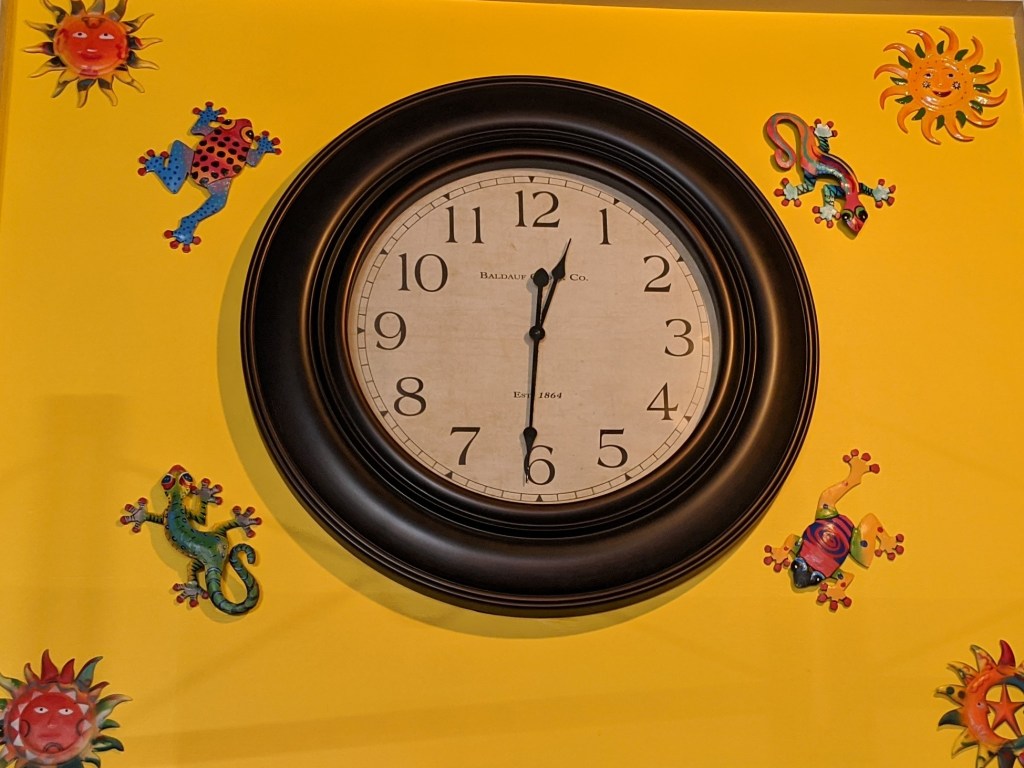
Despite decimalization and digitization, we still split our day into two twelve-hour blocks. Twelve o’clock represents both the zenith of the sun and the nadir of the night. Twelve is a factor of sixty, the basis for the sexagesimal system, first used some twenty-four centuries ago, and surviving today in our computation of seconds and minutes.
There is there nothing as primal as the process of preparing food, and nothing as intimate as consuming it. So, it is no surprise that twelve injects itself into nutrition. Baking sheets are sized for a dozen biscuits. Recipes produce a dozen rolls of bread. We expect there to be a dozen eggs in the carton we buy. Police buy a dozen doughnuts at a time. (So we’re told.) Canned drinks come in packages of a dozen. Food, the essential support of life, is duodecimal.


Is our attachment to the number twelve more cultural than natural? If so, it may explain why its very name is noteworthy. In the English language, and other Germanic-influenced languages, twelve is the largest number that has a single syllable – douze, twaalf, zwölf, tolv. But if culture attaches us to the concept of a dozen, religion – which underpins so many traditions – has bonded us to it. Consider the twelve apostles of Christ, the twelve tribes of Israel, twelve petals in Anahata, and the patriarchs of almost every faith having twelve sons. (Sadly, these gentlemen never seemed to have any daughters. We will pity them.)
Twelve’s connection to the sacred is mirrored in its connection to the profane. When accused of a crime, twelve of our peers must judge us. A dozen pennies once defined a shilling. (Oh, filthy lucre!) There are twelve inches in a foot. Economies of scale are referred to as being ‘cheaper by the dozen’. And the route back from alcoholism includes twelve steps.
However, despite the cultural connotations of the number, it’s our bodies that prove the connection to twelve is predominantly organic. Medicine defines twelve body systems. We have twelve cranial nerves. Healthy people have twelve pairs of ribs. We can point to each finger bone in our hand with our thumb and count to twelve.
These dainty bones show us that four and three are factors of twelve. We force the created world to imitate our hands. The ratio of four by three appears in furniture design, photo sizing, and so many other things humans choose to make. In design, the ratio 4:3 is an instinctive organization of space and is pleasing to the human eye.
The numbers eleven and thirteen are discordant in a way the number twelve is not. We are discommoded by eleven roses. We never gamble on number thirteen. But twelve is comfortable, trustworthy, and reliable. The modern world may operate in base ten, but the dozen (base twelve) is a unit we refuse to abandon. There is no objective reason why twelve is so weighty, yet it is. Our rational intellects may think it is an innocuous number, but our emotional minds know otherwise.
Follow The Numerate Ninny on Facebook, Instagram, Twitter, LinkedIn or at: https://thenumerateninny.com/
Find my books on all Amazon platforms.

Yikes! A room full of men!

Those who are inconsiderate enough to be younger than me are comfortable sharing their hopes and youthful certainty with strangers through social media. I am one of those strangers – an Instagram novice who follows various individuals and organizations that fall broadly under the category of ‘STEMgirls’.
From various STEMgirl posts, a peculiar repetition of sentiment has become apparent. A significant minority of my virtual friends have expressed how challenging it is to be the only woman in the room.
I have tried to understand this sentiment, although the underlying message eludes me. But to live is to learn, so I’ve spent some time contemplating the matter.
I’ve asked myself if I should feel awkward when I am the only woman in the room? Am I abnormal in that I failed to experience suitable discomfort during the decades of my career? Do I need therapy to make me feel appropriately discombobulated?
Perhaps while I sat in conference rooms in the past, I should have been apprehensive of male conspiracies. Perhaps men colluded behind my back to hide my calculator and have a giggle about it. Perhaps, unknown to me, men made puerile faces while I was distracted by the contents of my handbag. Perhaps men fed me coffee so that I would have to visit the site’s port-a-potty. Wait! This particular evil actually happened!
Or perhaps such male machinations are a figment of my imagination.

Whatever my opinion, the fact remains that young women in STEM are wary of the men they work with. I wonder whether the origin of their guardedness lies with men or with women, with the young or with the old. Did they imbibe that fear from tales of my generation or was it derived from their own experiences?
Perhaps it was naïve of me, in my progress through life, to presume that the natural consequence of choosing a male-dominated profession was that I would often be the only female in the room. Perhaps it was naive of me to anticipate that a room full of men would be a room full of decent human beings. Perhaps it was naïve of me to presume that the meeting agenda was the real agenda of the meeting.
When in a room full of men, I presume we are a group of individuals gathered together to achieve a common goal. I presume that, allowing for common human frailties, we will work together to achieve our objective. I do not anticipate harm in that room. I believe in my safety. I expect respect.
What’s the alternative? Should I judge men by their gender? Should I presuppose male antipathy towards me because of an accident of birth? Should I pre-judge my male clients and colleagues, and conclude they are biased? Clearly the answer is no. Prejudice does as much harm to the instigator as the object of that prejudice. I choose not to poison myself in that way.
That choice is not always easy or intuitive, and I have not always been consistent in that choice. Experience sometimes leads me to abandon it, but it is too worthy a choice to fully renounce.
I do not ignore the fact that women have been overtly disrespected, spat at, and physically attacked in business meetings. The worst of these horrors capture our attention because, thankfully, they are rare events. Individual men commit these wrongdoings, and those individuals are contemptible. However, there is no male conspiracy. The majority of men in the room refrain from, or deflect, or act to protect against such spiteful behaviors. To judge an entire gender by the actions of a few is to demean half the human population and yourself.
A STEMgirl wants to be respected as a professional, judged by her performance, and seen as competent in her field. In the workplace, she wants to be seen as a pragmatic, useful person first, and a female second. If this is to be, then she must extend the same courtesy to her peers.
Younger sisters, when you enter a conference room, your first thought must not be that it is a room full of men. It should be that it is a room full of unique people who bring their individual talents to the purpose at hand. In the working environment, the people in the room are professionals first, and men second.
Follow The Numerate Ninny on Facebook, Instagram, Twitter, LinkedIn or at: https://thenumerateninny.com/
Find my books on all Amazon platforms.
Fire Hydrants of North America
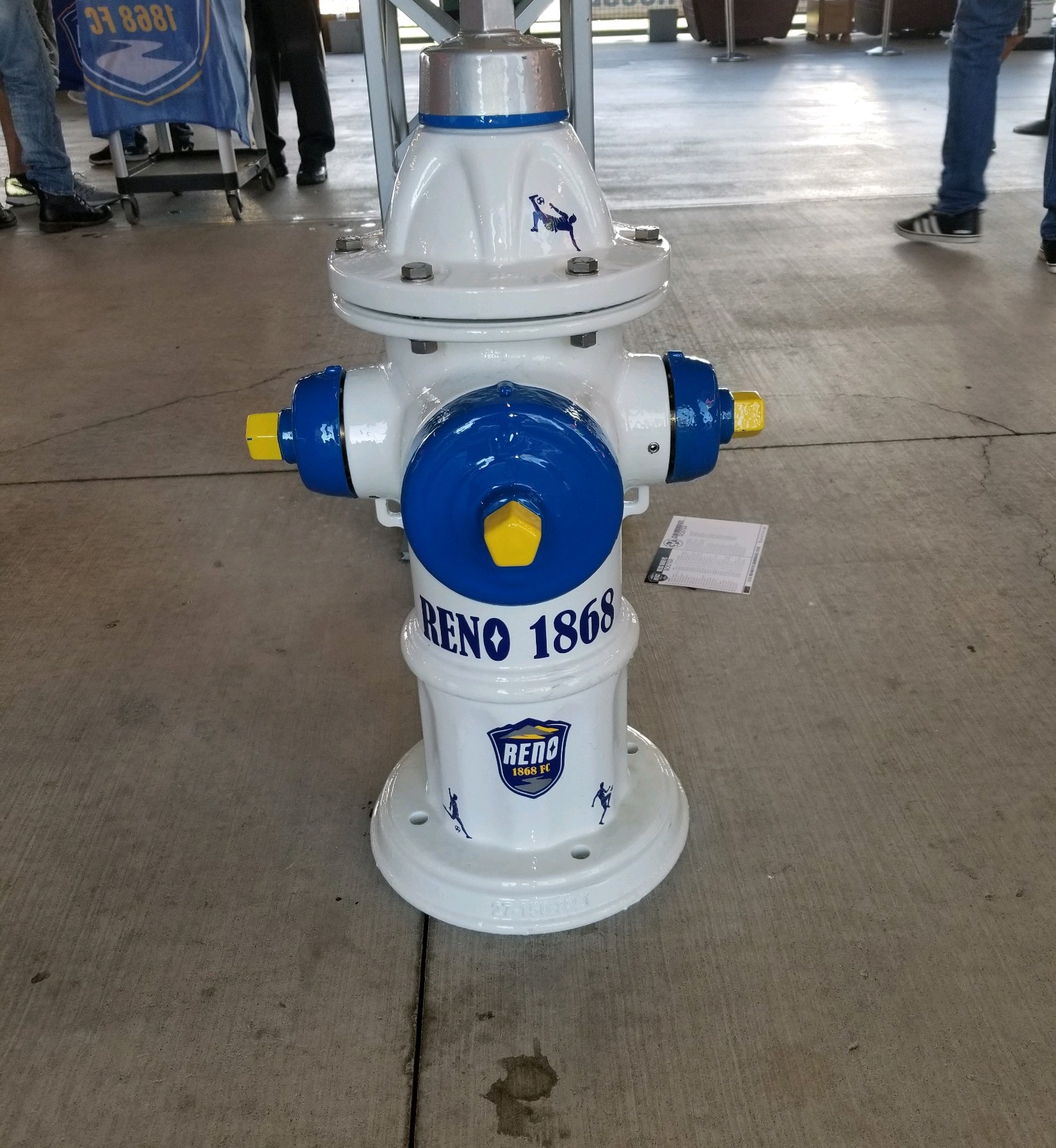
Since I have praised the aesthetics of Irish fire hydrants, it seems appropriate to present some pretty pictures of American fire hydrants – or at least those I have stumbled across in the western US. (Not literally – my eyesight is still somewhat functional.)
Of course, the hydrant shown above is purely for show. It is a piece of decor found at Greater Nevada Field, Reno, NV, home of 1868 FC.
Unlike their Irish relatives, American fire hydrants brazenly claim their spot on the pavement with a burly presence that has become iconic. Not for them a retiring presence underground with a humble identification marker. That modesty is left to their transatlantic peers. What this says about national character, I will leave you to contemplate.
Whatever continent you reside on, aesthetics remain important in the built environment. I found the hydrant below in Mount Shasta, California. It is both functional and pretty:

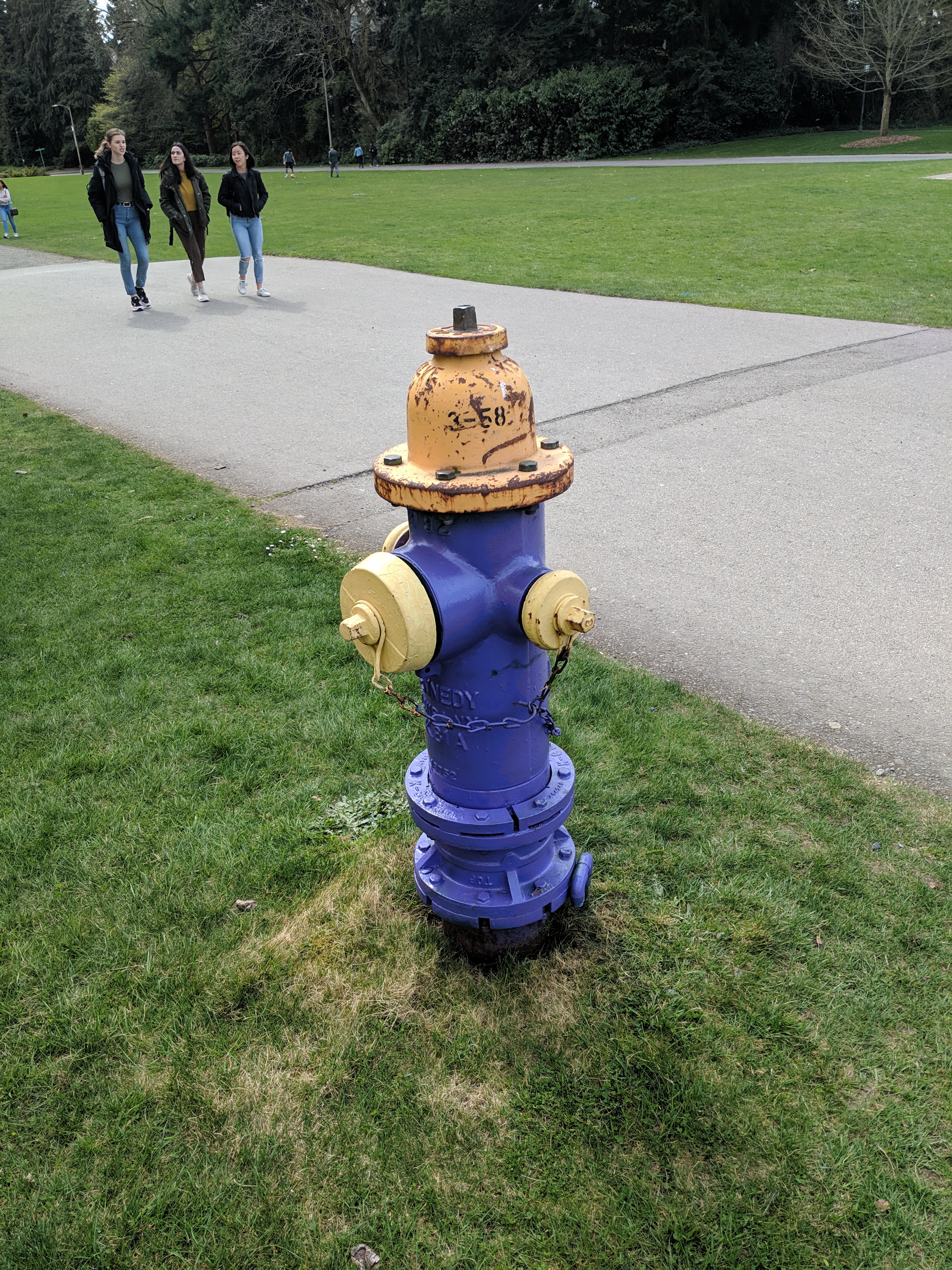
Although hydrant colors are supposed to relate to the available flowrate from the device (per NFPA Standards), it is up to the local government to adopt the standard or not. Local regulations can allow variations. For example, this non-standard purple and yellow, um, beauty was spotted at the University of Washington, Seattle:
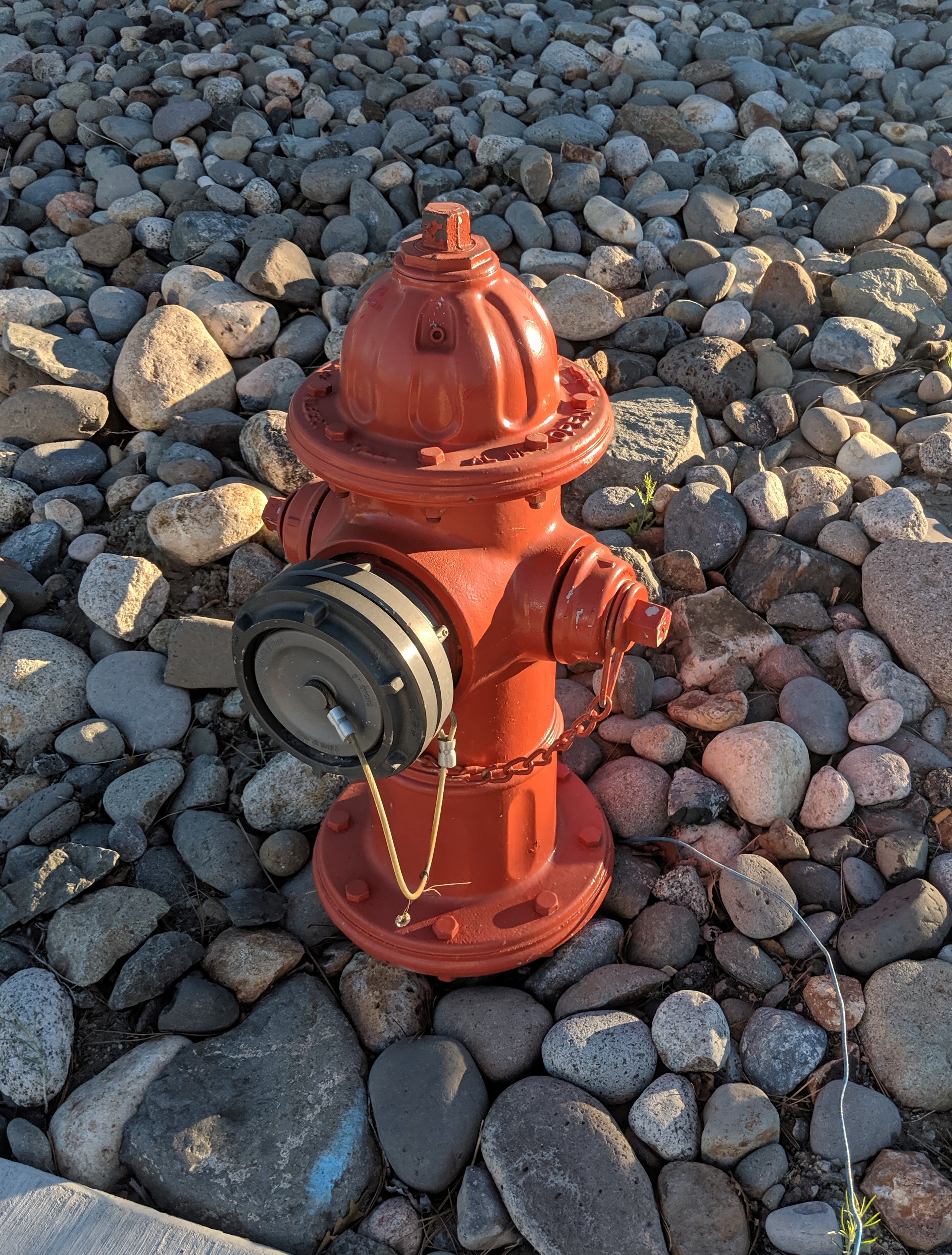
Most hydrants have traditional threaded connections, but some jurisdictions prefer those with quick connect couplings. The largest coupling, at the front, allows the hydrant to be connected to a fire truck pumper. (Even after a quarter century in the US, that word still makes me cringe). Fire hose can be connected directly to the two smaller connections on the hydrant.
The example below, with a quick connect coupling, was spotted in Carson City, Nevada. This hydrant also conveniently fulfills our notion that fire equipment should be red:
The modern fire threat definitely includes scrub or brush fires. We hope that all hydrants are accessible when a fire occurs. They should not surrounded by combustible material. This example of a compromised hydrant (and its better positioned neighbor) was spotted in Stateline, Nevada:
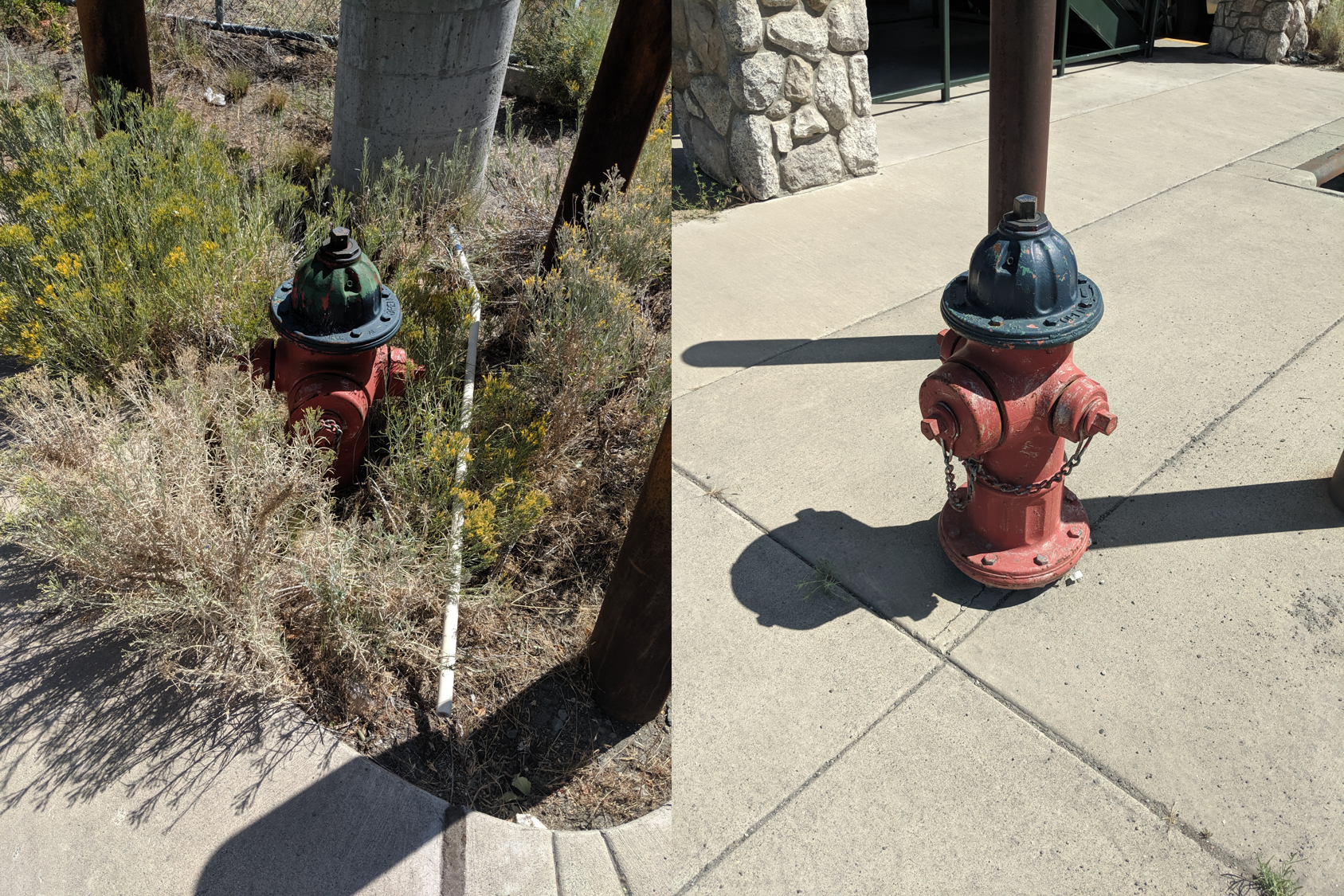
The most important hydrant of all is the one that protects your home. This buttercup is three houses down from my place of residence. Sad to say, it has been used to deal with three house fires on my street in the last half-decade (and there are only ten houses on our cul-de-sac). Desert winds, wood construction, and cooking fatty meats are a dangerous combination. Clearly vegetarianism is the key to fire safety.

And of course, fire hydrants are purposeless without the human responders who operate them. So, thank you, City of Sparks Fire Department. And please don’t take this the wrong way, but I hope never to see you near my home again.

Find my books on all Amazon Platforms.
Follow The Numerate Ninny (a licensed fire protection engineer and a somewhat scattered middle-aged woman) on Facebook, Instagram, Twitter, LinkedIn or at: https://thenumerateninny.com/
See other posts about fire hydrants:
https://thenumerateninny.com/?p=1333
https://thenumerateninny.com/2019/08/14/fire-hydrants-of-ireland/
A Countdown Deal

Get my second book for a discount price between August 21st and August 28th on amazon.com and .co.uk.
I would tell you more about the book if could but, unfortunately, even I don’t know what genre it is. (And I wrote the darn thing!) It might be Space Opera or it might be Romance. Who can tell…
However, if you are half my age or less, you should definitely view the novel as a Space Opera.
Why? Because the protagonist is – shall we admit it – a person of middle years.
Young people, please protect yourself from the awful concept that old people are subject to romantic feelings. Otherwise, your sensitive young minds will suffer extreme psychological damage.
Follow The Numerate Ninny on Facebook, Instagram, Twitter, LinkedIn or at: https://thenumerateninny.com/
Find her books on all Amazon platforms.
Fire Hydrants of Ireland
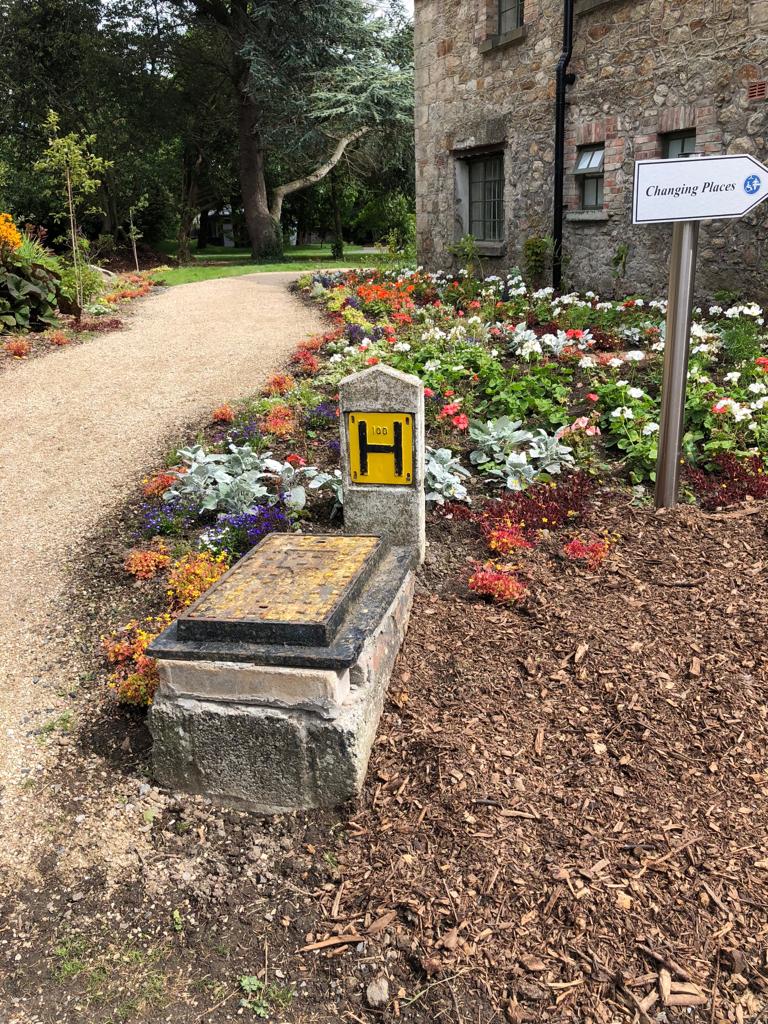
They are ubiquitous, innocuous, and sometimes picturesque. They may be ignored but they are always important. Let me present a visual tour of the Fire Hydrants of Ireland.
Hydrant signs are often found in the landscaping:
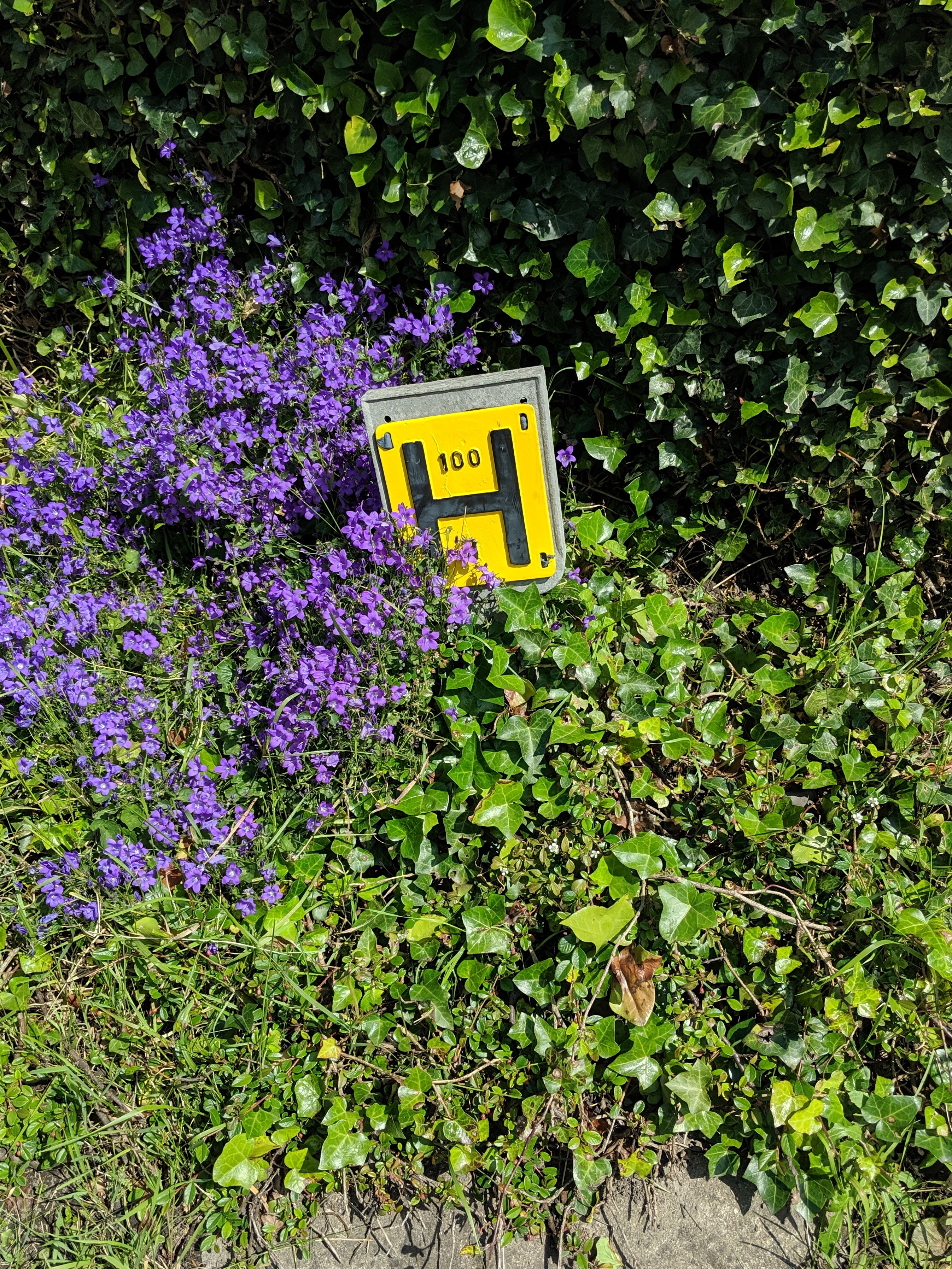
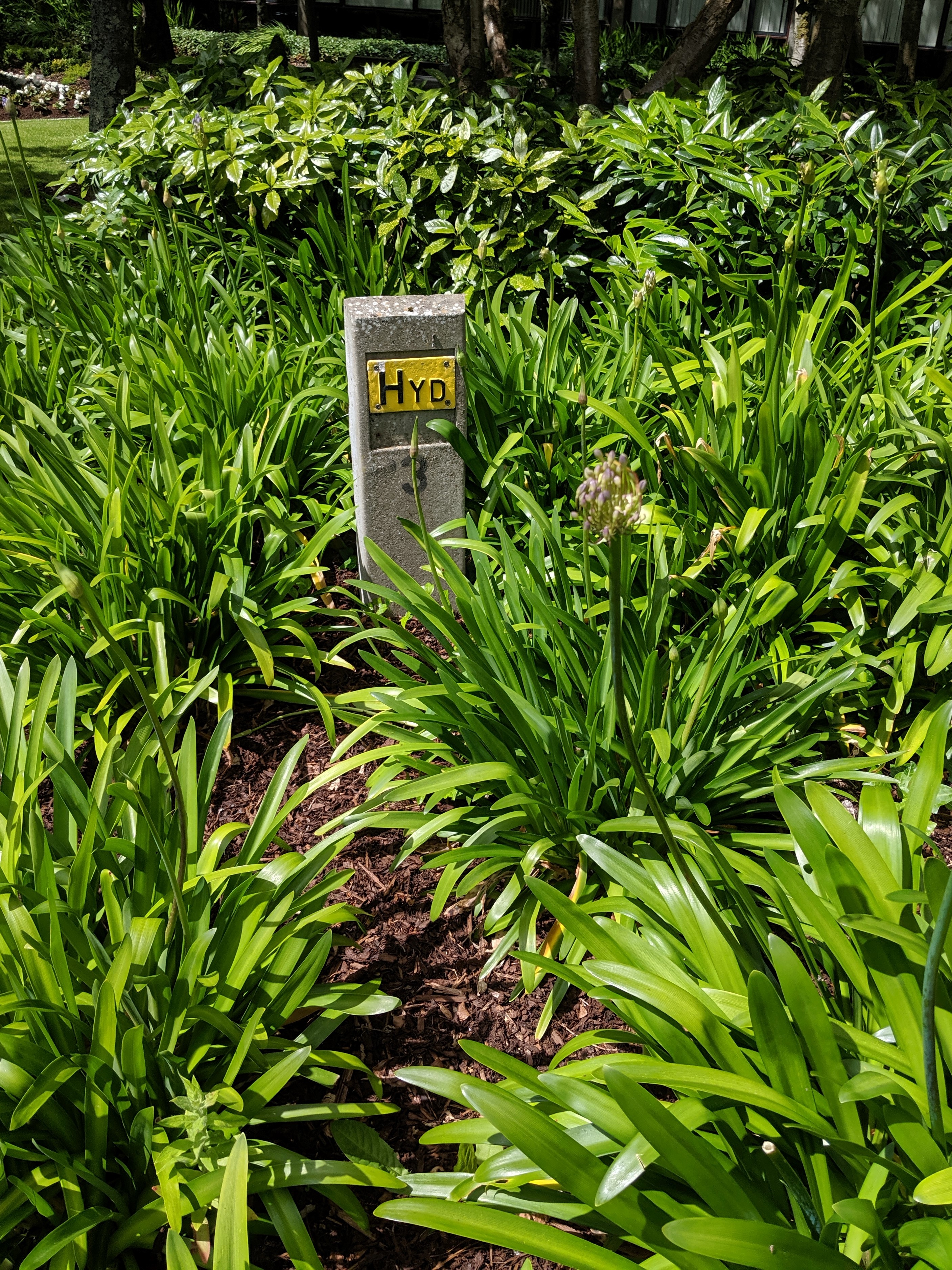

The black H with the yellow background is used to identify a hydrant location – usually within a metre of the sign.
A variety of covers protect the hydrant connections. Unlike American-style hydrants, these hydrants do not occupy precious space on the narrow streets of Ireland’s older towns.

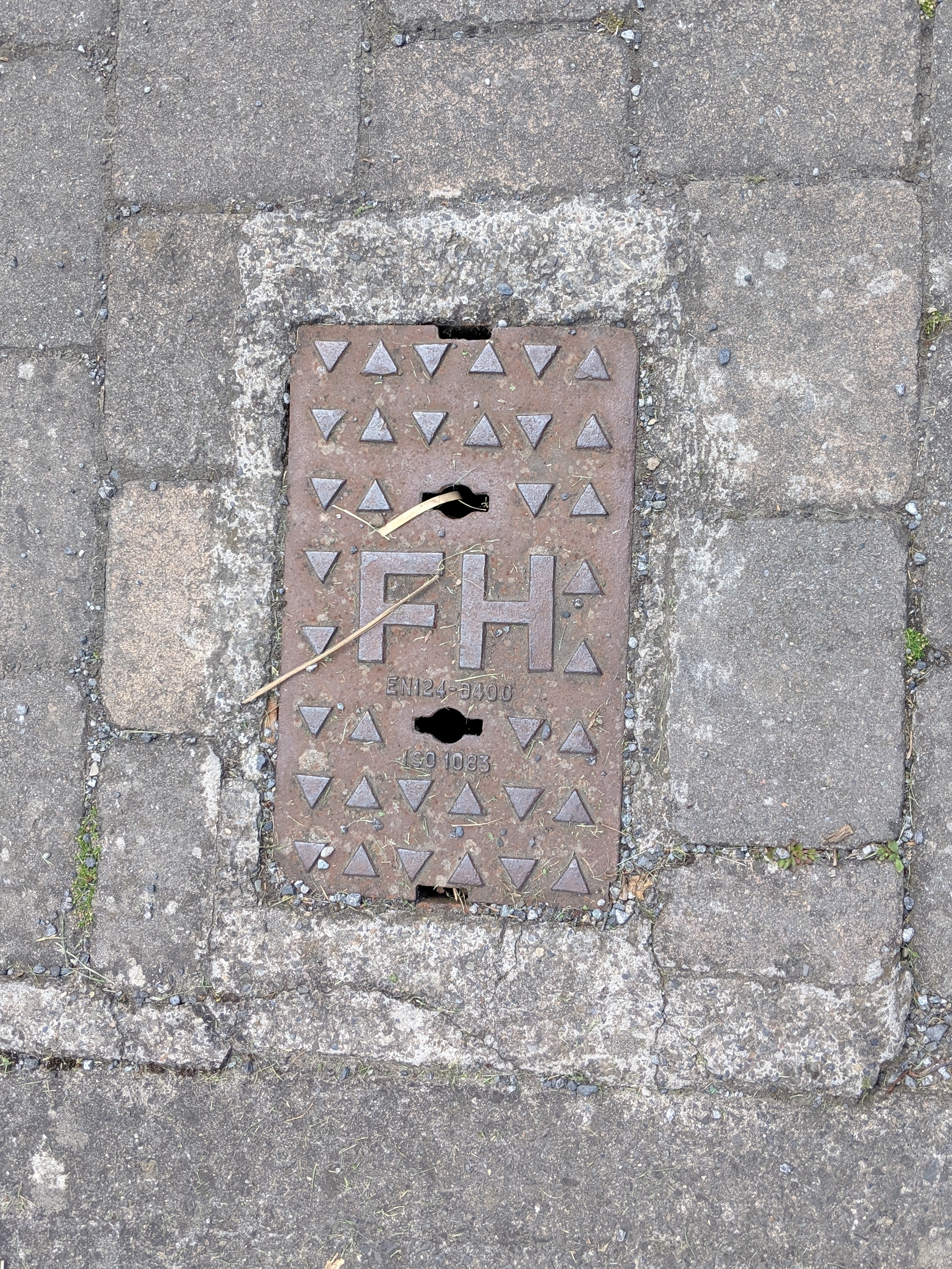
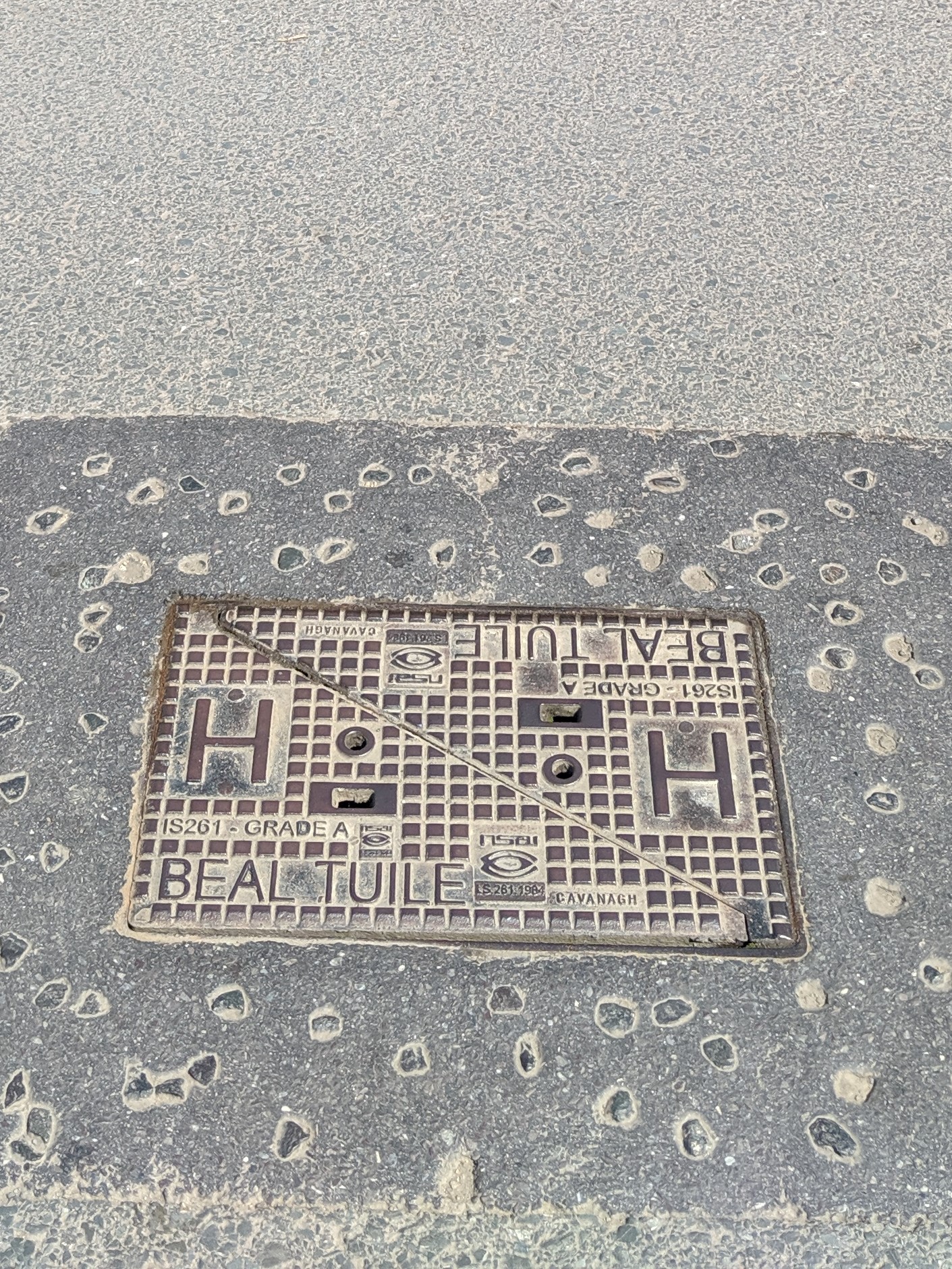

However, underground fire hydrants present their own problems. The importance of the odd little cover is not always recognized.
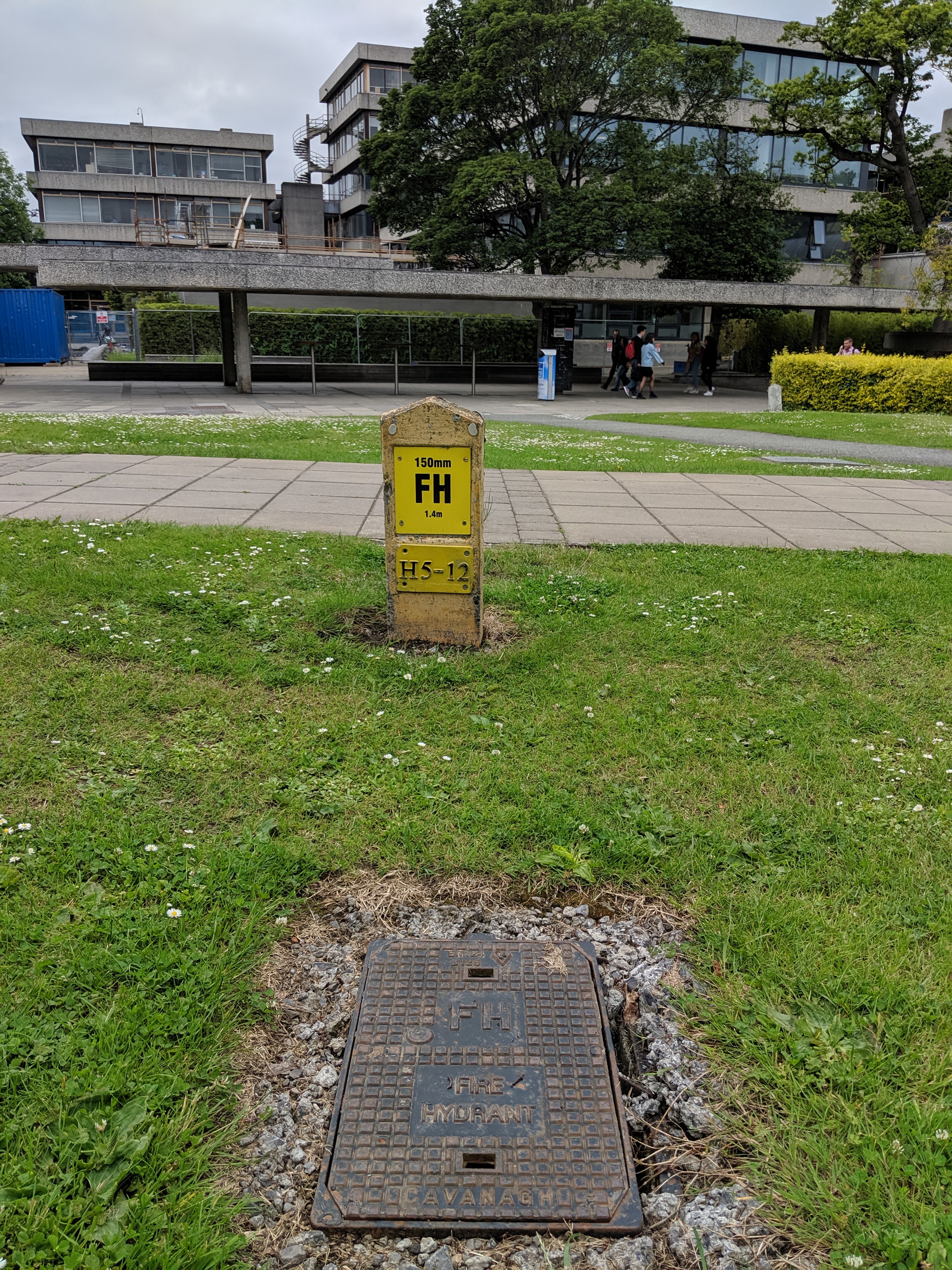
Irish drivers have sharp eyes for good parking spots, but they often fail to spot the capital H. As a result, it’s not uncommon for a parked vehicle to block access to the hydrant itself – as observed here at UCC (Cork).
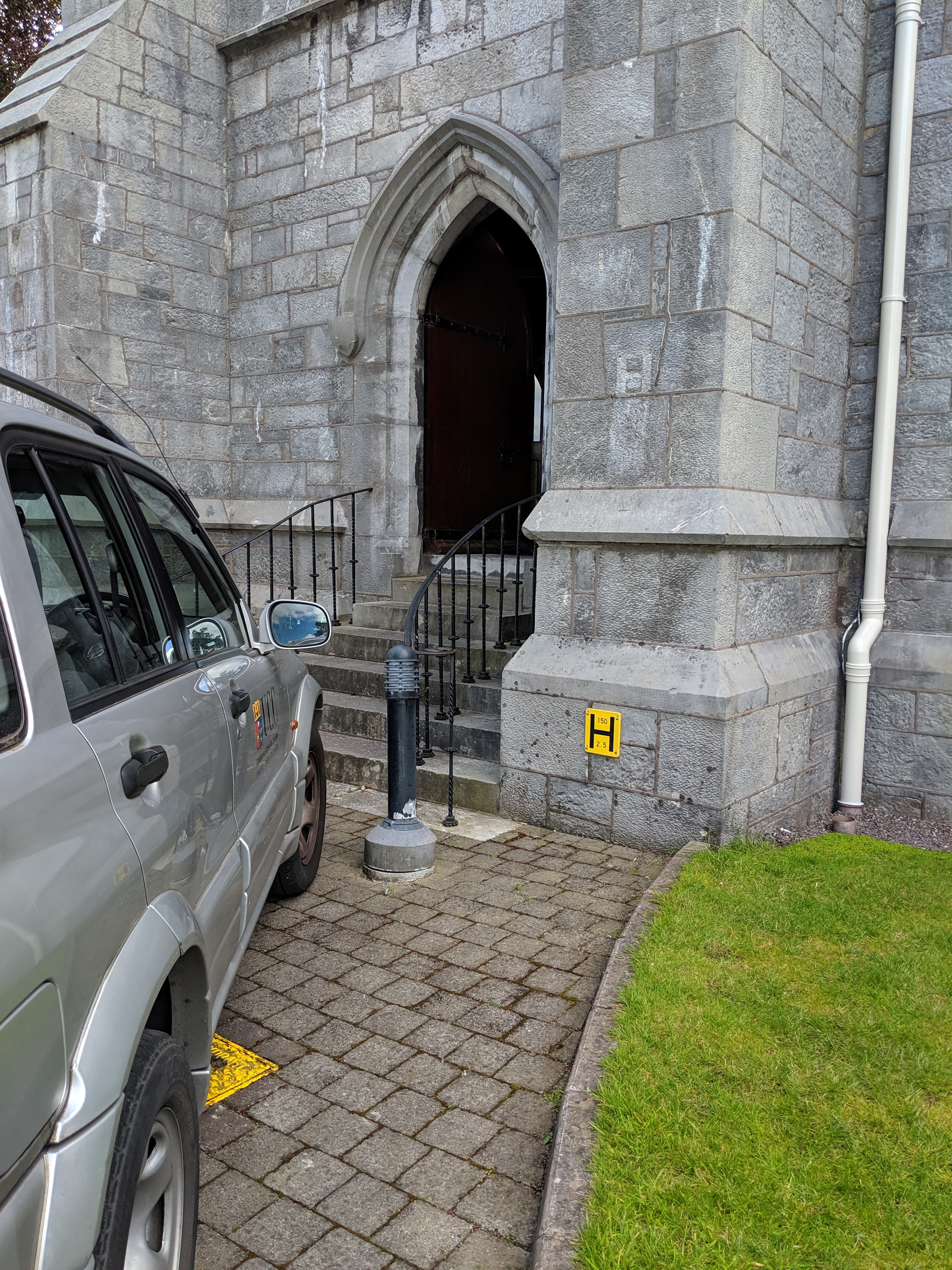
It’s many years since I first saw firefighters deal with a hydrant that was inaccessible because a car had parked over it. The firefighters in question were in their street clothes, attending a bachelor party, and very inebriated. With two men on either end of the car, they bounced the vehicle out of its parking spot, into the street (think traffic jam), and gained access to the hydrant. They then left the scene to continue their carousing.
And they probably ruined the vehicle’s suspension in the process. I almost pitied the driver.
To be fair to drivers, I admit that hydrants can be hard to spot – as in this barely noticed example in Skerries, Co. Dublin.

And the fire hydrant’s placement can be questionable. Was this hydrant placed in an inaccessible spot to prevent cars parking over it? (NUIG – Galway)
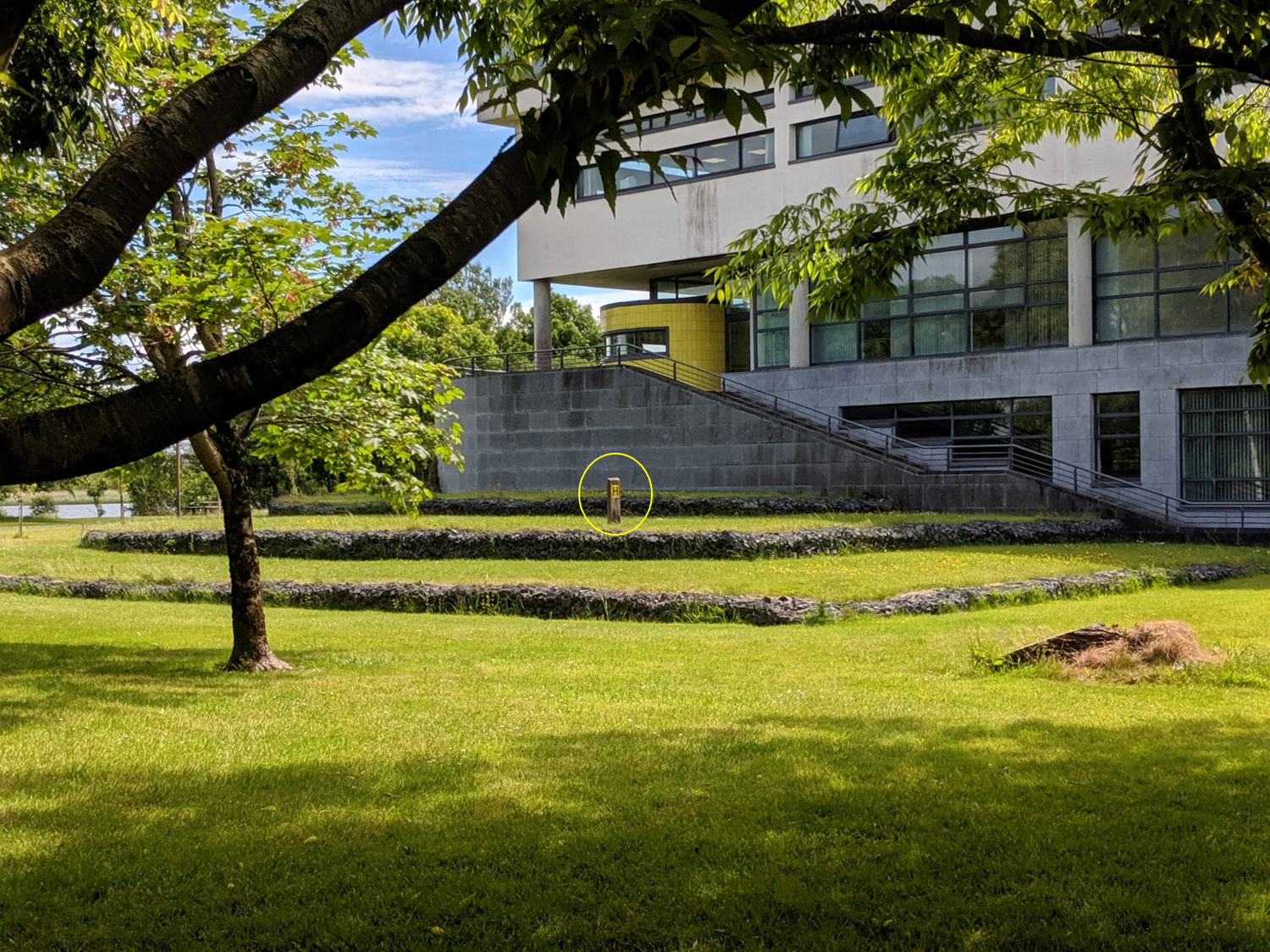
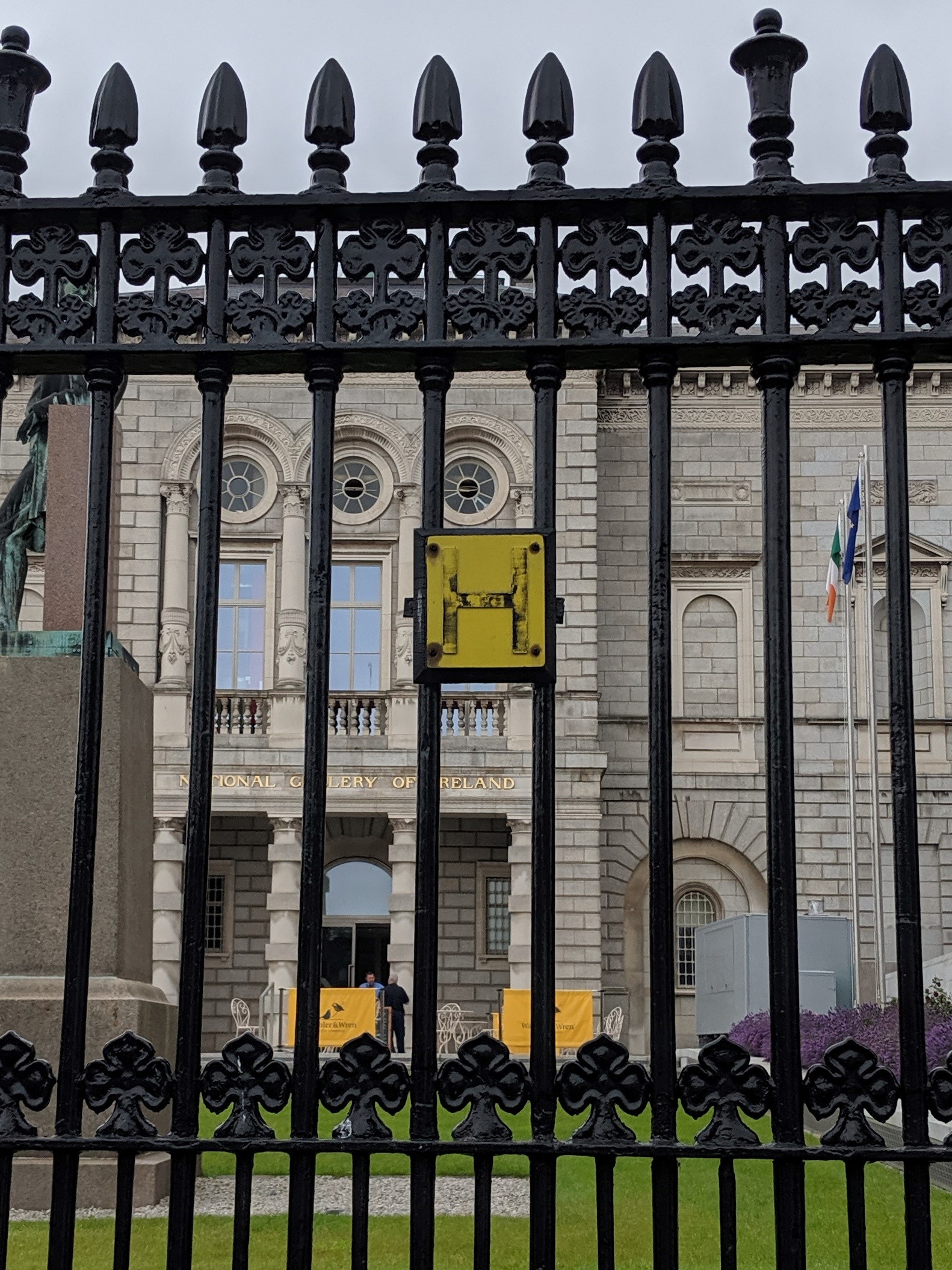
Fire hydrants can be found in prestigious locations. (National Gallery of Ireland, Dublin)
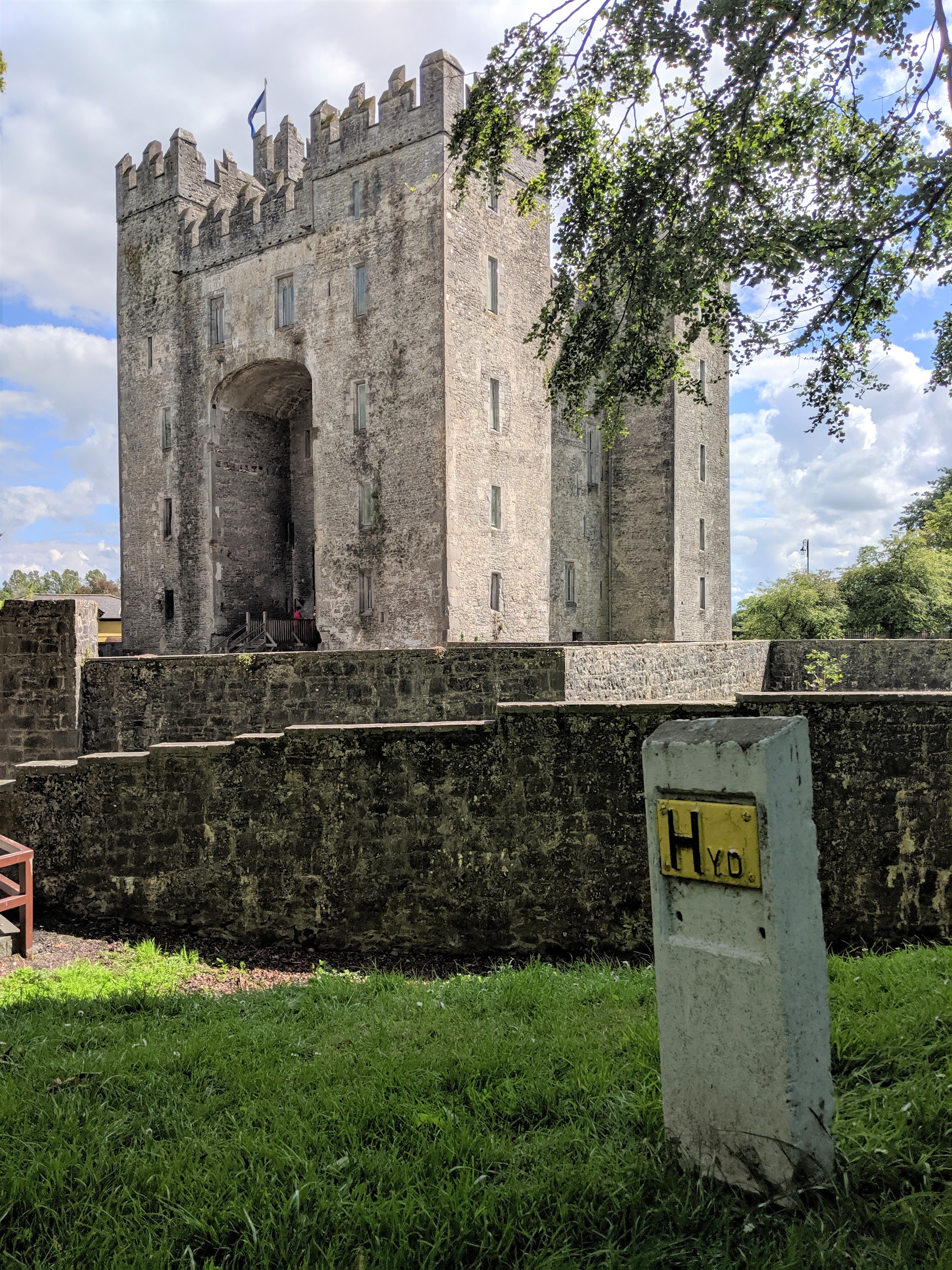
Or here at Bunratty Castle. (Yes, even stone castles need fire protection. Why else would medieval siege technology involve flinging burning objects at a stronghold?)
Trinity College, Dublin may also be considered a prestigious location. It is the oldest university in Ireland. But even though two of my sisters have connections to the place…

Anyone with any sense knows that UCD is more the thing. (It’s my alma mater.)
However, the most important fire hydrant is the one that protects the family home.
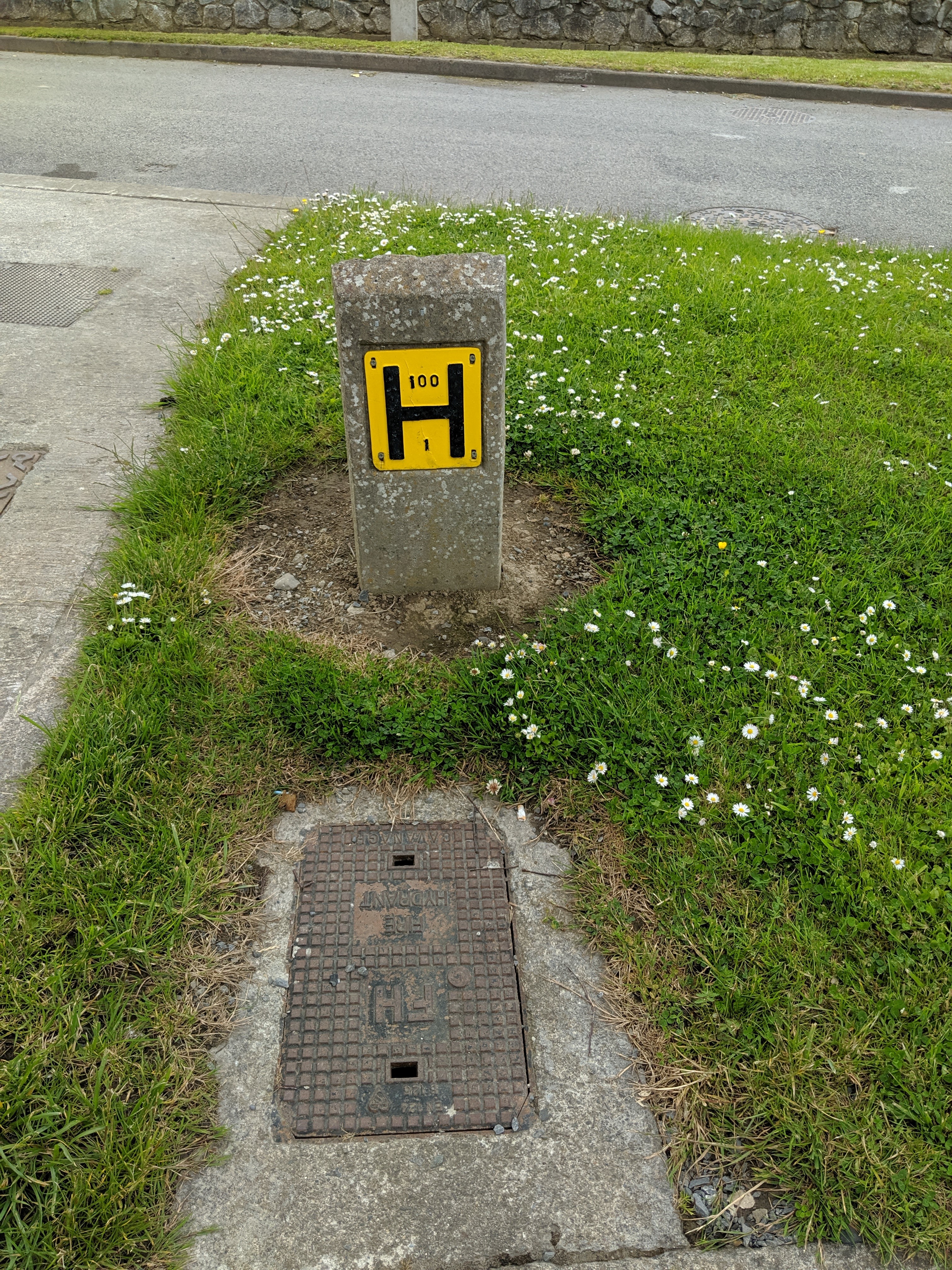
So, if the need arises, the fire brigade can do its thing.

Find my books on all Amazon platforms.
Follow The Numerate Ninny (a licensed fire protection engineer) on Facebook, Instagram, Twitter, LinkedIn or at: https://thenumerateninny.com/
Thanks to Paula Norris for the cover image of a hydrant at Marley Park, Rathfarnham.
View other posts about fire hydrants:
https://thenumerateninny.com/2019/09/21/fire-hydrants-of-north-america/
The Two-Year-Old Engineer
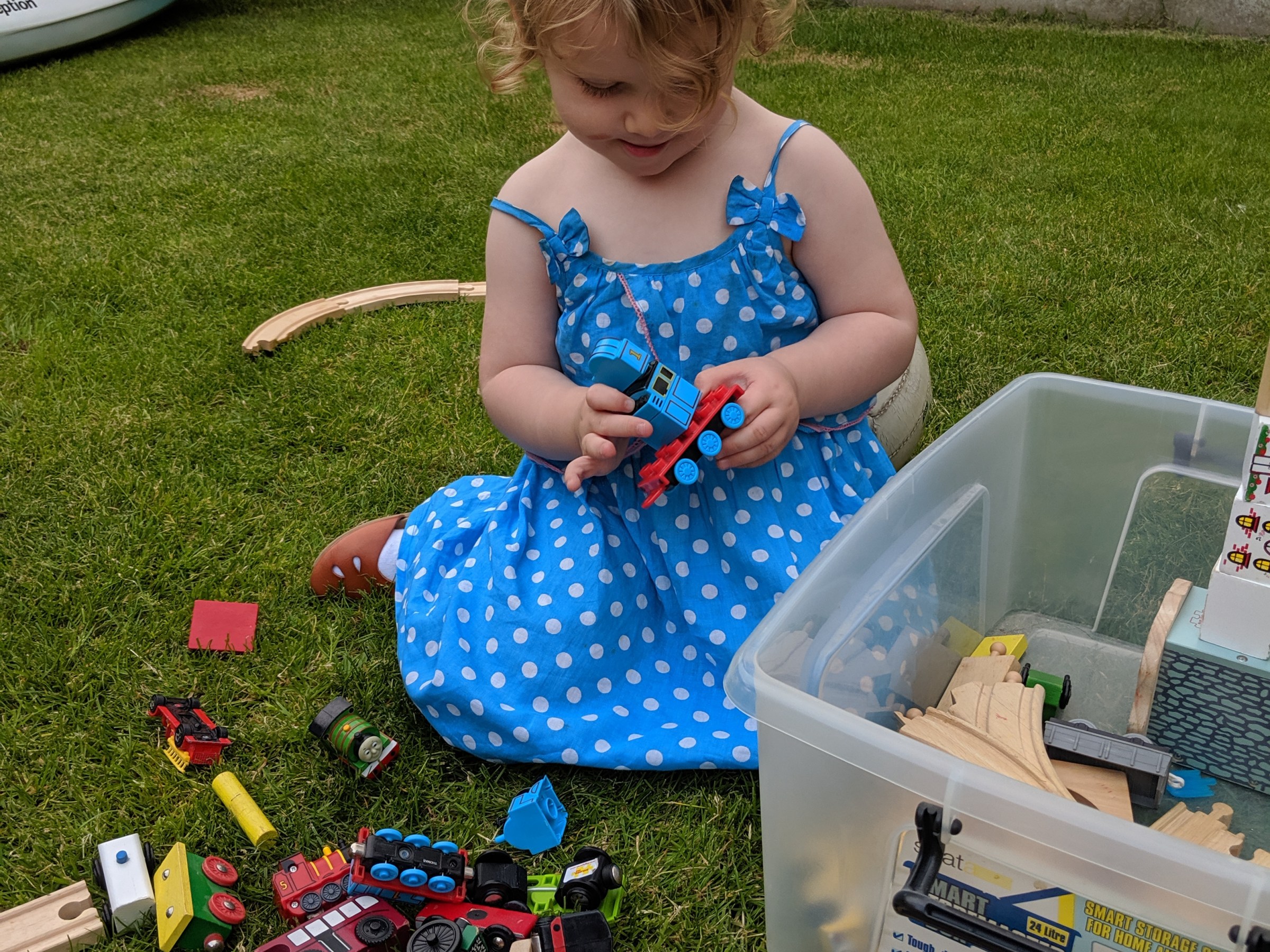
Recently, I had the privilege of watching my 2½ year-old grandniece, Penny Rose, at play. Deeply engaged with a Thomas the Tank Engine Lego set, she connected the brick with Thomas’s face to a foundation brick. She then tried to place a piece of Thomas’s body beside his big happy grin. But Thomas’s nose stuck out and prevented placement! Undeterred, she removed Thomas’s face-brick, put it at one end of the base piece and successfully connected all three pieces of Thomas’s body. Not content with these efforts, she disassembled her work and explored other configurations to determine which would work and which would not.
You don’t need to be an educator to understand that this little toddler was developing her spatial reasoning skills – and you don’t need to be a great-aunt to be impressed by the little one’s focus.
“She’s going to be an engineer,” this auntie declared proudly, as the little girl worked on.
This was a more significant declaration than you might think. I have often lamented my lack of familial connections to engineering. Family history says I have an ancestor who was a boilerman in the days when boilers were fickle things that needed constant feeding to make them work and coddling to prevent them from exploding. However, there were no living technical mentors within the family circle when I was a child. In fact, I never even met an engineer until I went to university.
Alas, my subsequent life experience has taught me that those who grow up in an engineering household are more prepared for the profession than those who do not. Engineers breed engineers, or so it seems. My engineer-free upbringing was a professional disadvantage. Woe be me. So, to see a petite person connected to me by blood enamored with practical geometry was a special treat.
It would be a genetic stretch to say that my grandniece inherited some special aptitude from a great aunt who is an engineer. Penny’s mother’s abilities are more aesthetic than technical. (In fact, I should apologize to my stylish niece for my perennial frumpiness.) On the other hand, Penny’s dad, unconnected to me by birth, is a mechanic. Her abilities likely come from him.
We all know there was a time when women were declared – by virtue of their gender – to be devoid of certain skills, talents, and abilities. In fact, I am old enough to have heard such prejudices declared openly. (Hard to believe I’m that ancient, is it not?)
But even when I was still a tiny thing, I had trouble rationalizing these established notions. I saw little girls inherit their father’s looks, musical talents, and medical complaints. I could not determine how they were barred from inheriting their father’s technical skills, athletic abilities, or ability to reason.
Yet society assured us that girls were incompetent at tasks that involved scientific knowledge, spatial awareness, or mathematical skills. This was supposed to be true even if they were descended from a male line with proven excellence in those fields. (The female line had little opportunity to prove anything, of course.) The accepted and false logic was that male skills were passed to sons (even those who were very like their mothers) and those same skills bypassed daughters (even those who were very like their fathers).
As a result of these commonly postulated viewpoints, young girls and women who declared an interest in engineering, or other ‘manly’ professions, had their declaration met with exclamations of “You can’t do that”. This retort was often accompanied by a laugh or a sneer or some other variant on contempt. The negativity had a double meaning. Women could not do that because they were both deficient in ability and because doing that was not permitted by society.
Sadly, my belief that I belonged to the last generation to be exposed to this nonsense has recently been shattered. Through social media, I have become aware that the youngest of women in STEM fields feel the resonance of chauvinistic opinions that were once so openly expressed. I can only hope that, since such prejudicial comments are now rarely voiced aloud, young women stay long enough in their STEM professions to make the concept of female competence utterly unremarkable, yawningly boring, and unworthy of comment.
As for Penny Rose, when I repeated my thoughts on her future profession, her dad proudly announced, “I’d be all right with that”. Well done, Denis! The world needs more of that attitude.
Follow The Numerate Ninny on Facebook, Instagram, Twitter, LinkedIn or at: https://thenumerateninny.com/
Find my books on all Amazon platforms.
A Personal History in honor of Women in Engineering Day: The Summer of ’89
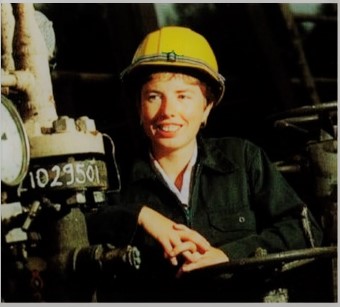
Ladies, how did your predecessors deal with topless and nude calendars in the workplace? In honor of Women in Engineering Day, The Numerate Ninny presents an extended post on this historic topic:
I’m going to bring you back to the summer of 1989 where we will visit an elderly petrochemical plant in Baglan Bay, south Wales (not New South Wales). In the center of this plant, there was a squat, unbecoming building with a narrow, poorly lit hallway. And at the end of this dim corridor sat two under-valued rooms – the soon to be extinct file room and the graduate engineer’s office.
This office would look foreign to your modern eye. Four ugly desks were stuffed, back to back, into the cramped space. The only electronics in this hive of engineering were four keypad telephones – firmly tethered to the wall – and four scientific calculators. There were no computers or monitors to block one employee’s view of the other. Desks were piled with paper, and bulging shelves supported maintenance manuals and schedules.
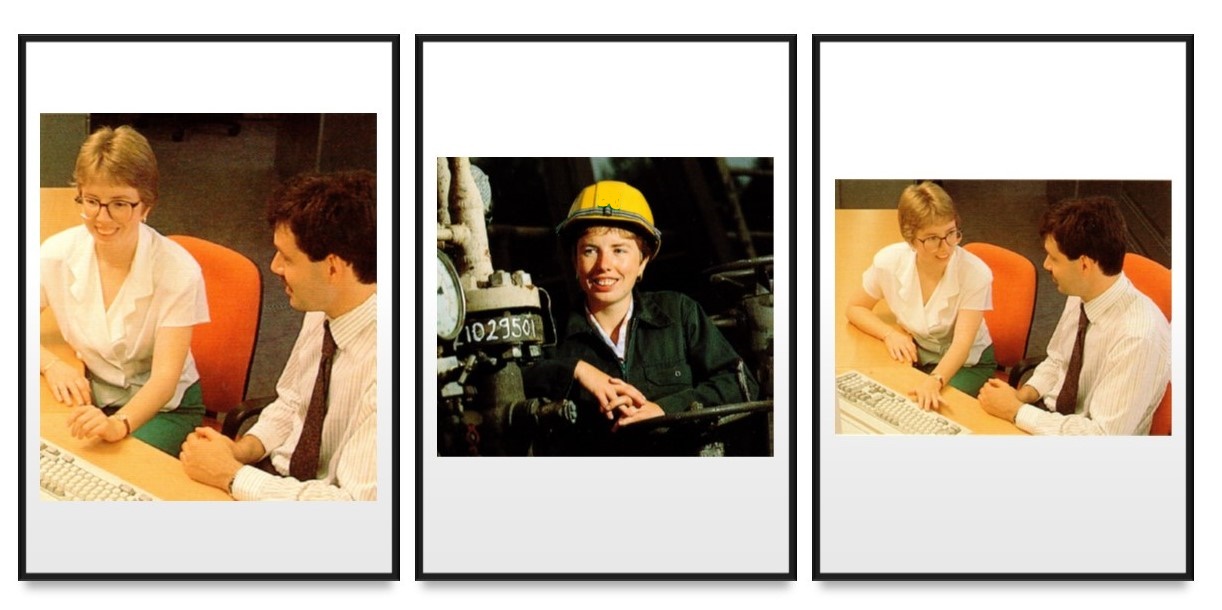
The occupants of this functional space were surprisingly diverse for the era. Although all were pale skinned, freshly minted mechanical engineers, each had a different nationality. In addition to that, and quite remarkably, there was a perfect gender balance in this little office. Ireland’s and Scotland’s representatives in this confluence of nations were female engineers.
I (the Irish engineer) rather admired my Scottish colleague who was at ease in every social situation. In fact, I thought her impervious to embarrassment until the day we both happened to be in a workshop at the same time. On this noteworthy occasion, I was startled to observe this poised young woman battling social discomfort. Her aplomb had been severely challenged by the pernicious presence of topless calendars on almost every vertical surface.
In this environment, she and I mirrored each other’s behavior. When conversing with the foremen, we carefully positioned ourselves so that there was no dubious calendar behind us nor one in our line of sight. Neither of us felt professional when we, or the person we were talking to, were looking at boobs.
Nude and topless calendars were pervasive – and normal – in the workplace. As the customary gift from vendor to client, they were used to advertise every type of part, kit, and service. My youthful self cringed at the connection between a buxom woman wearing a thong, a hard hat, and high heels, and the reciprocating compressor she was promoting. Was there logic in placing a naked girl behind a well-placed safety barricade to advertise mechanical seals? What was the psychological connection between the images on the calendars and the products being sold? Not unsurprisingly, I questioned the mentality of the men I worked with.
But I’m tending to the negative. Let me attempt to present a more balanced view of this topic. There were positives for women engineers who were exposed to this workplace peculiarity.
If a vendor happened to venture down to my stuffy little office, it was to expend minimal effort wooing the new engineers. (After all, we possessed only tiny amounts of that desirable quality, purchasing authority.) Usually, after a brief presentation of his company’s products and services, the vendor would reach into his briefcase to pull out a gift. The Englishman and the Welshman in the office received the conventional freebie – the topless calendar. However, when the vendor turned to the other engineers in the office, he flustered, turned red, and stared in panic at the stash of goodies in his briefcase. The women engineers would then share a smug look. The vendor could only sigh as he came to the inevitable conclusion.
Poor man! He was obliged to give the female engineers the expensive gifts normally reserved for more significant persons. While the young male engineers received low-quality artwork depicting the female bosom, the young women received leather diaries, logo-laden pens and fancy paperweights. On one memorable occasion, a manufacturer’s representative had nothing wholesome to offer and glumly presented me with his own personal pen. I took it without a qualm. It was a small recompense for the uncomfortable nature of the material he had just handed to my peers.
And so, by judicious evasion, the female engineers feigned ignorance of the workplace décor until…
One Friday, at the end of the day, I returned to my desk. As I dumped my safety gear, the unobstructed view of the wall behind my colleague’s desk became a curse. There, in contravention of an unspoken courtesy, hung an unsavory calendar – and it was no commonplace calendar sporting a topless woman. Not at all! The calendar showed a woman photographed at a most peculiar angle. In fact, had I been medically trained, I could have diagnosed the woman’s gynecological problems quite readily.
This was too much to tolerate. A line had been crossed. But what to do? Going to human resources with such concerns was unheard of in that day and age. Could I complain to management? I had little contact with local management on a routine basis. They were renowned for sitting in the ‘ivory tower’ of the main building by the front gate. Technically, I reported to a manager in the corporate office; I was on loan to the site for the Big Shutdown. Although I considered complaining to my corporate manager, I knew if I stirred things up in that way, I would sour things for more than just myself.
My greatest concern was that I would be labelled as one of those women. The label was professional death. My work got done because I was not one of those people. I saw what happened when an engineer was not respected by the trades. Projects ground to a halt at every minor difficulty – until the engineer happened to discover the crew standing about ‘waiting for instructions’. Thankfully, this type of prevarication had not been part of my experience. My crews told me immediately if there was a problem, and they usually had a solution to suggest to their inexperienced engineer. I got things done. I got things completed. But if I became a complainer, I knew that would change.
All these thoughts flashed rapidly through my mind as I sat at an ugly desk in a pre-war chemical plant on a sunny evening in the summer of 1989. Whatever the consequences of the course of action I chose to take, I knew that I could not stare at Miss Gynecology for the rest of the summer.
Realizing that there was no simple solution to my problem, I consoled myself that I had a whole weekend to determine a way forward, and I went home.
The solution to my problem was shopping – as it so often is.
Here, I must temporarily divert from the main thread of the story to include some relevant information.
At that time, my home was close enough to the high street to allow me to walk there each Saturday. The disadvantage of this proximity was that I had to pass, on foot, an active construction site. I will refrain from reporting the unsavory words and hand gestures directed at any young woman who proved her sexual availability by walking past this worksite with her head down. However, it is pertinent to describe the construction workers’ form of dress – sturdy shoes, jeans, sometimes a hardhat, and work gloves, but nothing else. They wore no shirts. This is a pertinent point.
On the Saturday in question, after surviving the treacherous journey past ‘hardworking’ men, I delighted in the discovery of a solution to my professional problem. It was on display outside a tiny retailer. I popped in to make a purchase.
On Monday morning, I arrived early at work in order to execute my plan. Once everything was in place, I sat decorously at my desk.
I had not long to wait. Within minutes, my Welsh colleague deposited himself at the desk opposite my own. He mumbled a greeting, removed his jacket, and shuffled papers. I continued to sit primly with my hands clasped in front of me. At long last, he glanced up and saw what was on the wall behind my desk. He turned an angry shade of beetroot. It was a rather satisfying reaction.
“I AM NOT SITTING HERE ALL DAY LOOKING AT THAT,” he snarled as he pointed at my new poster.
Primness abandoned, I retorted with equal vigor, “And I am not spending all day looking at that!” I pointed at Miss Gynecology, who was directly behind his desk.
He threw his thumb behind him. “That stays,” he growled.
Throwing a thumb over my own shoulder I declared, “So, does that!”
We stared each other down.
We were at an impasse.
My intent to negotiate a removal of all wall décor was summarily abandoned.
In the meantime, our English and the Scottish colleagues had arrived and caught the gist of the exchange. They looked at each other in concern, fearing their workspace was about to become a battlefield. They need not have worried. We all spent most of our time out in the facility, and none of us were assigned to the same plant. The Welshman and I successfully ignored each other for the rest of the summer without impacting our effectiveness on the job.
I know you are wondering what was so objectionable about the large poster I’d installed on the wall behind my desk. In fact, there was nothing offensive about it at all. It was merely a three-quarter image of a model dressed in the same clothing as the construction workers I had passed only two days before. He was a shirtless man in jeans – a form of dress that I knew from observation was acceptable on a jobsite. Unlike Miss Gynecology, this man was modestly covering all his private parts.
However, the poster depicted a man who was young, beautiful, and attractively toned. His thick hair was expertly coiffed into a then-fashionable wave. He held his hands close to his belt and gifted us ladies with a look that clearly said come hither. In other words – and unlike Miss Gynecology 1989 – he managed to be demur, classy, and enticing all at the same time.
Do you remember that the chemical plant was a long-established one? For generation after generation, men from the local community had trod the path from the front gate to the control rooms. Fathers had worked together. Sons had worked together. In short, the social connections among the employees were unparalleled. This facility was the gossipiest place I’ve ever worked. So, naturally, the Irish-Welsh conflict became instant conversational fodder. Henry’s presence on site (yes, my paper hero was christened Handsome Henry) was known to all.
Something changed.
Suddenly, the senior engineers discovered the cramped office at the end of the narrow corridor. After being ignored and left floundering, the new engineers were inundated with visitors. Naturally, these experienced engineers had come to provide guidance to their younger peers. Of course, they had come to talk about work. But why, oh why, did they stare at Henry? Did Miss Gynecology deserve no attention? She had made so much effort to be noticed, after all. It was so very odd!
And then, to top it all, the unbelievable occurred. The Big Boss arrived. This was a man with so much engineering experience that it was whispered, in reverent and awed voices, that he had previously managed rotating equipment that was bigger and more powerful than that found in our treasured 120 MW powerplant.
To our complete amazement, this god of engineering emerged from the ivory tower where he reigned in isolation and deigned to grace our little office with his presence. On this singular occasion, all four of the junior mechanical engineers happened to be present.
The Big Boss engaged in conversation with the Englishman first, chatted about his work, and shared a titbit of information that solved an intractable technical problem. The Scottish woman and I exchanged a look of wonder at his engineering genius. Then he spoke with the excited Welshman – but oh so briefly – and the poor lad looked quite deflated when the Big Boss turned away. To the self-assured Scottish engineer, he delivered some congratulatory words. And then, finally he faced me, but not to engage in professional banter. He eyed Henry sternly.
“Who’s that, Amanda?” he asked.
“That’s a picture of you, Boss, when you were a young man” I responded without missing a beat.
The venerable gentleman lifted a rakish eyebrow, straightened his spine, and proudly pulled his belt up over his generously sized abdomen. He gave a little smile that had – I’m confident – been almost sexy in the mid-1960s.
“Very good. Very good,” he murmured in a satisfied tone and departed.
The Welshman glowered at me from across our desks. I preened in victory.
And this is the end of the tale of Handsome Henry and the very much neglected Miss Gynecology 1989. The Big Shutdown edged to completion and I, perforce, had to move to a new location. However, it was unbearable to think of Henry crushed in my little hatchback with my other belongings. He deserved better than that. I let it be known that Henry needed a good home. A senior process engineer asked if he could have Henry ‘for his wife’. Despite being a chemical engineer, he was a nice man. I trusted ‘his wife’ to take good care of my paper hero.
Follow The Numerate Ninny on Facebook, Instagram, Twitter, LinkedIn or at: https://thenumerateninny.com/
Find my books on all Amazon platforms.
Life on Earth – as I Know It!

Even though it’s a space opera, you’ll find sideways references to life on Earth as I know it between the covers of my current book, Lightfoot.
In the novel, there are two oblique references to Irish history (try to find both), one to The Hitchhiker’s Guide to the Galaxy, and at least one direct quote from Jane Austen.
What kind of ninny quotes Jane Austen in a science fiction book? The answer is me.
Being a self-published author gives me the freedom to have some fun and please myself.
With this in mind, I named a secondary character in Lightfoot after someone I know in real life. (Some of you may recognize the name.) And an alien character gets her hair styled by the same person as I do – but not in a salon in Reno, Nevada. A spaceship in the parking lot would cause too much of a stir, I suspect.
In addition to that, my protagonist corresponds with a Haitian humanitarian I’ve emailed in the past – and who is definitely resident on Planet Earth. In a fit of highhandedness, I married off a business acquaintance to the leader of a space fleet, quite without her permission. At least her fictional marriage is a happy one. Perhaps I should let her know…
Shouldn’t writing be fun?

My books are available on all Amazon platforms, and the link for Lightfoot on Amazon.com is below.
Follow The Numerate Ninny on Facebook, Instagram, Twitter, LinkedIn or at: https://thenumerateninny.com/
Free Ebook for the Fabulously Frugal

The ebook version of Massoud by Amanda Norris is FREE on Amazon for three days only!
Make sure to let your fabulously frugal friends know! If they like romance or space operas (or getting free stuff), this book will be for them.
This offer is available for 3 days only – May 29th, 30th and 31st starting midnight Pacific Time.
Download the ebook to read later. Download it onto all our family’s devices. Download wherever, but not whenever.
If you don’t have a Kindle reader, you can still get the book. Download the Kindle app on your smart device and then search for the book title.
Here is the amazon.com – link but the ebook is available on all Amazon platforms:
Follow The Numerate Ninny on Facebook, Twitter, LinkedIn or at: https://thenumerateninny.com/
Don’t Buy My Book Because…
To mark the release of my second book, Lightfoot, I will soon make my first ebook (Massoud by Amanda Norris) FREE for three days only. Mark your calendar!
Download a copy of Massoud from Amazon.com, Amazon.co.uk, Amazon.de and other Amazon platforms on these dates only – May 29th, 30th and 31st. The promotion starts at midnight Pacific Time (GMT -8hrs).
Share this promotion with your most frugal friends. Download the book onto your Mom’s device as a late Mother’s day gift. Download it for Dad too, so he doesn’t feel left out.
The link for Amazon.com is below:
Is an an Amazon Kindle device needed to read a Kindle ebook? No, it isn’t.
On your smart device (phone or tablet) go to your app store, search for Kindle or Amazon Kindle. Download the app.
Once it is ready to go, you can search for and download Massoud by Amanda Norris. Do this during the promotion period and the ebook will be free.
However, you should definitely buy my second book Lightfoot!😊 Although it has some plot links to Massoud, it can be read as a stand-alone novel.
Follow The Numerate Ninny on Instagram, Facebook, Twitter, LinkedIn or at: https://thenumerateninny.com
 thenumerateninny.com