thenumerateninny.com
Natterings of a Woman in STEM
The Eleventh Hour
At the eleventh hour, of the eleventh day, of the eleventh month, hostilities ceased in one of history’s most brutal conflicts.
One hundred years has passed since the Armistice – the moment that ended a war jingoistically known as The Great War, optimistically known as The War to End All Wars, and which was ultimately, and sadly, re-titled The First World War.
One hundred years, 1,200 months, 5,218 weeks, or 36,524 days separate us from a war that stole an estimated 19,000,000 individuals from the human population. I defy you to understand what 19,000,000 million means in this context. I am a numerate person, and I can’t comprehend it, no matter how I try.
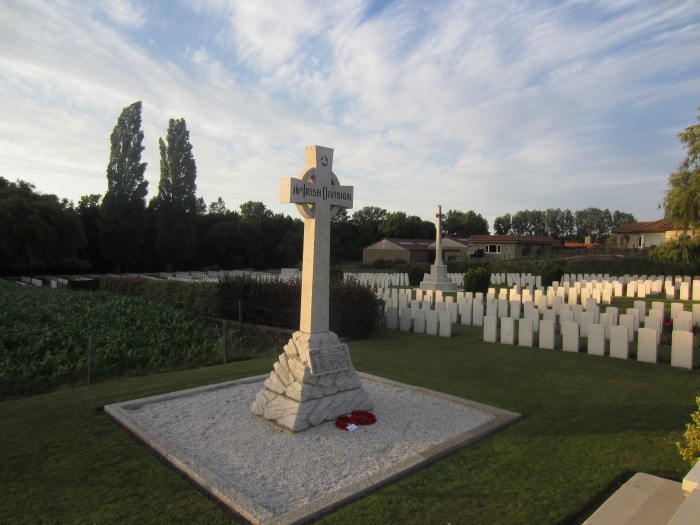
I try to imagine the equivalent of four nations the size of Ireland being eviscerated. I am incapable of doing so.
I try to imagine the estimated 750,000 German civilians who died of slow malnutrition during those years. I fail.
I try to imagine the 49,000 Irish men who perished in the Great War. Although a smaller number, I still cannot grasp its meaning.
I try to imagine one life ending, and the empty crater it leaves in the lives of those left behind – people who hope that the edges of that great gaping hole gradually wear away until the battered landscape of their life is passable again. And then I try to imagine that loss multiplied nineteen million times. I cannot calculate the incalculable.
In 2014, one hundred years after the war’s commencement, I stood under the arch of Menin Gate, Ypres, and witnessed the solemn sounding of the Last Post, a poignant ceremony conducted by the local fire brigade each night for most of the last century. In honor of the centennial, letters from the fallen were being read aloud. I listened to the last letter written by an English officer who complained bitterly of his sergeant’s noisy death. He wrote of nightmares, nightmares of his own demise – not that his death concerned him; his horror was that he might be buried with the horses. He was seventeen years old when he succumbed to the Great Falling.
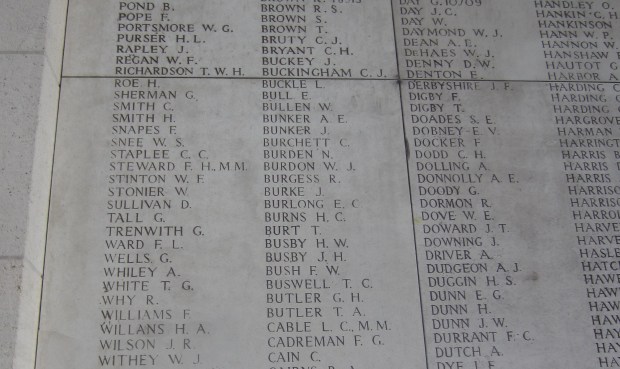
I searched the 54,395 names inscribed on the monumental gate for one familiar to me, and it was no surprise that I found the name of my own seventeen year-old son carved into the cold stone arch above my head. His first initial and his surname were etched there, chillingly memorializing another woman’s son. And finally, here was something I could understand; that a mother whose tears had long since dissipated in the wind, and whose heart had crumbled to dust before I was born, had mourned the loss of a son, who bore the name of my own precious child.
To learn more, I recommend:
The Great Courses – World War I
Follow The Numerate Ninny at:
 thenumerateninny.com
A powerful piece indeed.
I have stood in those graveyards amidst the crosses and stones, gazed at the names of those not found on the walls and felt the same sense of powerless incomprehension.
Lest we forget.
Gill
LikeLike
Your beautiful words elicit so many sad emotions and being in a profession where my main goal is to solve problems, I respond to your words by saying “why” and I also say “how could this have been prevented?” We can only be in the present and remind people that what has happened can happen and that we need to be vigilant against those who would carry us into another abyss like this.
LikeLike
When I was at the Menin Gate Memorial I found a soldier with my surname and thought about someone’s son. When I went home I found that he was from my home town and had lived in the same street as I did. Not only that, his name was on the Memorial of my old school. Lest we forget.
LikeLike
John – It is so sad to think that there are so many names on the gate, that finding a connection is not difficult. Nonetheless, your connection is remarkable. – The Ninny
LikeLike