thenumerateninny.com
Natterings of a Woman in STEM
A Personal History in honor of Women in Engineering Day: The Summer of ’89
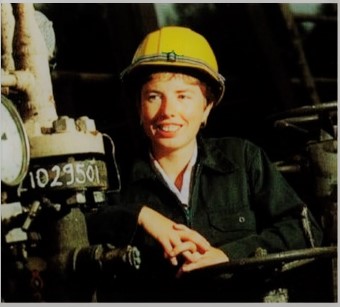
Ladies, how did your predecessors deal with topless and nude calendars in the workplace? In honor of Women in Engineering Day, The Numerate Ninny presents an extended post on this historic topic:
I’m going to bring you back to the summer of 1989 where we will visit an elderly petrochemical plant in Baglan Bay, south Wales (not New South Wales). In the center of this plant, there was a squat, unbecoming building with a narrow, poorly lit hallway. And at the end of this dim corridor sat two under-valued rooms – the soon to be extinct file room and the graduate engineer’s office.
This office would look foreign to your modern eye. Four ugly desks were stuffed, back to back, into the cramped space. The only electronics in this hive of engineering were four keypad telephones – firmly tethered to the wall – and four scientific calculators. There were no computers or monitors to block one employee’s view of the other. Desks were piled with paper, and bulging shelves supported maintenance manuals and schedules.
The occupants of this functional space were surprisingly diverse for the era. Although all were pale skinned, freshly minted mechanical engineers, each had a different nationality. In addition to that, and quite remarkably, there was a perfect gender balance in this little office. Ireland’s and Scotland’s representatives in this confluence of nations were female engineers.
I (the Irish engineer) rather admired my Scottish colleague who was at ease in every social situation. In fact, I thought her impervious to embarrassment until the day we both happened to be in a workshop at the same time. On this noteworthy occasion, I was startled to observe this poised young woman battling social discomfort. Her aplomb had been severely challenged by the pernicious presence of topless calendars on almost every vertical surface.
In this environment, she and I mirrored each other’s behavior. When conversing with the foremen, we carefully positioned ourselves so that there was no dubious calendar behind us nor one in our line of sight. Neither of us felt professional when we, or the person we were talking to, were looking at boobs.
Nude and topless calendars were pervasive – and normal – in the workplace. As the customary gift from vendor to client, they were used to advertise every type of part, kit, and service. My youthful self cringed at the connection between a buxom woman wearing a thong, a hard hat, and high heels, and the reciprocating compressor she was promoting. Was there logic in placing a naked girl behind a well-placed safety barricade to advertise mechanical seals? What was the psychological connection between the images on the calendars and the products being sold? Not unsurprisingly, I questioned the mentality of the men I worked with.
But I’m tending to the negative. Let me attempt to present a more balanced view of this topic. There were positives for women engineers who were exposed to this workplace peculiarity.
If a vendor happened to venture down to my stuffy little office, it was to expend minimal effort wooing the new engineers. (After all, we possessed only tiny amounts of that desirable quality, purchasing authority.) Usually, after a brief presentation of his company’s products and services, the vendor would reach into his briefcase to pull out a gift. The Englishman and the Welshman in the office received the conventional freebie – the topless calendar. However, when the vendor turned to the other engineers in the office, he flustered, turned red, and stared in panic at the stash of goodies in his briefcase. The women engineers would then share a smug look. The vendor could only sigh as he came to the inevitable conclusion.
Poor man! He was obliged to give the female engineers the expensive gifts normally reserved for more significant persons. While the young male engineers received low-quality artwork depicting the female bosom, the young women received leather diaries, logo-laden pens and fancy paperweights. On one memorable occasion, a manufacturer’s representative had nothing wholesome to offer and glumly presented me with his own personal pen. I took it without a qualm. It was a small recompense for the uncomfortable nature of the material he had just handed to my peers.
And so, by judicious evasion, the female engineers feigned ignorance of the workplace décor until…
One Friday, at the end of the day, I returned to my desk. As I dumped my safety gear, the unobstructed view of the wall behind my colleague’s desk became a curse. There, in contravention of an unspoken courtesy, hung an unsavory calendar – and it was no commonplace calendar sporting a topless woman. Not at all! The calendar showed a woman photographed at a most peculiar angle. In fact, had I been medically trained, I could have diagnosed the woman’s gynecological problems quite readily.
This was too much to tolerate. A line had been crossed. But what to do? Going to human resources with such concerns was unheard of in that day and age. Could I complain to management? I had little contact with local management on a routine basis. They were renowned for sitting in the ‘ivory tower’ of the main building by the front gate. Technically, I reported to a manager in the corporate office; I was on loan to the site for the Big Shutdown. Although I considered complaining to my corporate manager, I knew if I stirred things up in that way, I would sour things for more than just myself.
My greatest concern was that I would be labelled as one of those women. The label was professional death. My work got done because I was not one of those people. I saw what happened when an engineer was not respected by the trades. Projects ground to a halt at every minor difficulty – until the engineer happened to discover the crew standing about ‘waiting for instructions’. Thankfully, this type of prevarication had not been part of my experience. My crews told me immediately if there was a problem, and they usually had a solution to suggest to their inexperienced engineer. I got things done. I got things completed. But if I became a complainer, I knew that would change.
All these thoughts flashed rapidly through my mind as I sat at an ugly desk in a pre-war chemical plant on a sunny evening in the summer of 1989. Whatever the consequences of the course of action I chose to take, I knew that I could not stare at Miss Gynecology for the rest of the summer.
Realizing that there was no simple solution to my problem, I consoled myself that I had a whole weekend to determine a way forward, and I went home.
The solution to my problem was shopping – as it so often is.
Here, I must temporarily divert from the main thread of the story to include some relevant information.
At that time, my home was close enough to the high street to allow me to walk there each Saturday. The disadvantage of this proximity was that I had to pass, on foot, an active construction site. I will refrain from reporting the unsavory words and hand gestures directed at any young woman who proved her sexual availability by walking past this worksite with her head down. However, it is pertinent to describe the construction workers’ form of dress – sturdy shoes, jeans, sometimes a hardhat, and work gloves, but nothing else. They wore no shirts. This is a pertinent point.
On the Saturday in question, after surviving the treacherous journey past ‘hardworking’ men, I delighted in the discovery of a solution to my professional problem. It was on display outside a tiny retailer. I popped in to make a purchase.
On Monday morning, I arrived early at work in order to execute my plan. Once everything was in place, I sat decorously at my desk.
I had not long to wait. Within minutes, my Welsh colleague deposited himself at the desk opposite my own. He mumbled a greeting, removed his jacket, and shuffled papers. I continued to sit primly with my hands clasped in front of me. At long last, he glanced up and saw what was on the wall behind my desk. He turned an angry shade of beetroot. It was a rather satisfying reaction.
“I AM NOT SITTING HERE ALL DAY LOOKING AT THAT,” he snarled as he pointed at my new poster.
Primness abandoned, I retorted with equal vigor, “And I am not spending all day looking at that!” I pointed at Miss Gynecology, who was directly behind his desk.
He threw his thumb behind him. “That stays,” he growled.
Throwing a thumb over my own shoulder I declared, “So, does that!”
We stared each other down.
We were at an impasse.
My intent to negotiate a removal of all wall décor was summarily abandoned.
In the meantime, our English and the Scottish colleagues had arrived and caught the gist of the exchange. They looked at each other in concern, fearing their workspace was about to become a battlefield. They need not have worried. We all spent most of our time out in the facility, and none of us were assigned to the same plant. The Welshman and I successfully ignored each other for the rest of the summer without impacting our effectiveness on the job.
I know you are wondering what was so objectionable about the large poster I’d installed on the wall behind my desk. In fact, there was nothing offensive about it at all. It was merely a three-quarter image of a model dressed in the same clothing as the construction workers I had passed only two days before. He was a shirtless man in jeans – a form of dress that I knew from observation was acceptable on a jobsite. Unlike Miss Gynecology, this man was modestly covering all his private parts.
However, the poster depicted a man who was young, beautiful, and attractively toned. His thick hair was expertly coiffed into a then-fashionable wave. He held his hands close to his belt and gifted us ladies with a look that clearly said come hither. In other words – and unlike Miss Gynecology 1989 – he managed to be demur, classy, and enticing all at the same time.
Do you remember that the chemical plant was a long-established one? For generation after generation, men from the local community had trod the path from the front gate to the control rooms. Fathers had worked together. Sons had worked together. In short, the social connections among the employees were unparalleled. This facility was the gossipiest place I’ve ever worked. So, naturally, the Irish-Welsh conflict became instant conversational fodder. Henry’s presence on site (yes, my paper hero was christened Handsome Henry) was known to all.
Something changed.
Suddenly, the senior engineers discovered the cramped office at the end of the narrow corridor. After being ignored and left floundering, the new engineers were inundated with visitors. Naturally, these experienced engineers had come to provide guidance to their younger peers. Of course, they had come to talk about work. But why, oh why, did they stare at Henry? Did Miss Gynecology deserve no attention? She had made so much effort to be noticed, after all. It was so very odd!
And then, to top it all, the unbelievable occurred. The Big Boss arrived. This was a man with so much engineering experience that it was whispered, in reverent and awed voices, that he had previously managed rotating equipment that was bigger and more powerful than that found in our treasured 120 MW powerplant.
To our complete amazement, this god of engineering emerged from the ivory tower where he reigned in isolation and deigned to grace our little office with his presence. On this singular occasion, all four of the junior mechanical engineers happened to be present.
The Big Boss engaged in conversation with the Englishman first, chatted about his work, and shared a titbit of information that solved an intractable technical problem. The Scottish woman and I exchanged a look of wonder at his engineering genius. Then he spoke with the excited Welshman – but oh so briefly – and the poor lad looked quite deflated when the Big Boss turned away. To the self-assured Scottish engineer, he delivered some congratulatory words. And then, finally he faced me, but not to engage in professional banter. He eyed Henry sternly.
“Who’s that, Amanda?” he asked.
“That’s a picture of you, Boss, when you were a young man” I responded without missing a beat.
The venerable gentleman lifted a rakish eyebrow, straightened his spine, and proudly pulled his belt up over his generously sized abdomen. He gave a little smile that had – I’m confident – been almost sexy in the mid-1960s.
“Very good. Very good,” he murmured in a satisfied tone and departed.
The Welshman glowered at me from across our desks. I preened in victory.
And this is the end of the tale of Handsome Henry and the very much neglected Miss Gynecology 1989. The Big Shutdown edged to completion and I, perforce, had to move to a new location. However, it was unbearable to think of Henry crushed in my little hatchback with my other belongings. He deserved better than that. I let it be known that Henry needed a good home. A senior process engineer asked if he could have Henry ‘for his wife’. Despite being a chemical engineer, he was a nice man. I trusted ‘his wife’ to take good care of my paper hero.
Follow The Numerate Ninny on Facebook, Instagram, Twitter, LinkedIn or at: https://thenumerateninny.com/
Find my books on all Amazon platforms.
 thenumerateninny.com
You replied to this comment.
LikeLike
Ha! Your ploy worked. Well done!
LikeLike
Wonderful story! I am researching the history of women in chemical engineering (for Heriot Watt Univ) and wondered if you might be willing to tell me any more about your female Scottish colleague?
Thanks
NIna
LikeLike
Hi Nina. Boy, I may be suffering from old woman syndrome, but remembering things from early in my career is an iffy program. However, I do remember that Hillary had graduated from a Scottish university (and was therefore better educated than her English and Welsh colleagues). She was very outgoing and confident, and had what we might call an inner light. She managed to squeeze in teaching Aerobics at a local community center. Now doesn’t that date things! I wish I had kept in touch, but my job required me to move every few months to wherever I was needed. It was a great learning experience, but it meant people cycled in and out of my life.
LikeLike